 |
| The report on my fellowship |
When telling others about the path they have taken to
Quakerism Friends often refer to their spiritual journey. This metaphor goes
back many centuries and encompasses a great variety of stories. I have the same
kind of narrative to share and this blog has been and continues to be one of
the ways in which I have done and am doing that. In Quaker terms journeys have
always been physical as well as metaphorical and when I travelled around the UK
in 1994 as a Joseph Rowntree Quaker Fellow encouraging Friends to write and
then share their spiritual autobiographies I felt that my journey continued
both sides of the tradition.
In the 17th century one of the ways in which
Quakerism was spread through the country was by pairs of travelling Friends,
known as ‘the Valiant Sixty’ by Quakers and as ‘Morris-dancers from the North’ by their opponents. They were supported,
financially and spiritually, by the organisation based in Swarthmoor Hall under
the leadership of George Fox and Margaret Fell. On their journeys they were
often welcomed and set up a network of meetings throughout England. Sometimes
they were attacked and imprisoned but this often spoke for them even louder
than their words and brought more to the Quaker way. Some also went further
afield to Ireland, America and Europe.
 |
| Swarthmoor Hall |
As Quaker practices became more established a need was felt
for more regulation of Friends’ journeys. In the early 18th century
a formal system of elders and overseers was set up and it became unacceptable
for Friends to go on religious journeys without the approval of their meetings.
A local meeting would ‘recognise’ those who it believed to have a particular
gift for vocal ministry and would support them if they had a concern to travel
either locally or further afield. Each minister would apply for, and usually be
given, a certificate which approved a particular journey. This was to be
presented to and endorsed by local Friends at each stage who would be expected
to aid the traveller with hospitality and whatever other assistance was
required. If a concern arose for the minister to travel further then another
certificate from their home meeting was required. On their return to their own
meeting the minister would return their
certificate and give an account of their journey.
As more ‘recognised’ Friends began to travel further their
names were ‘recorded’ centrally in London and this practice was formalised in
1773. Recorded Ministers were also known as ‘Public Friends’ and many of them
did indeed gain a national reputation, helped by the widespread publication of
their journals and records of their journeys. Many of the Friends whose lives I
am trying to make more widely known through my part in the Quaker Alphabet blog
were Recorded Ministers and Public Friends.
During my year as a Joseph Rowntree Quaker Fellow I visited
58 groups in half the Monthly Meetings
in Britain Yearly Meeting and spoke to more than 750 people. I travelled
over 9,500 miles, mostly by rail and far more comfortably than Public Friends in
earlier times. They often travelled hundreds of miles by foot or on horseback
on appalling roads and in dreadful weather. They crossed the Atlantic in both
directions and often found themselves in uncharted territory. They suffered
accidents and ill-health but were not deflected from their task. Given the
conditions under which journeys were undertaken in the 17th and 18th
centuries it is not surprising that the words ‘travel’ and ‘travail’ were used
interchangeably!
 |
| Susanna Morris's account |
There are so many examples of the rigours
encountered by travelling ministers on their journeys recorded in their journals
that it is hard to choose between them
but here are just three.
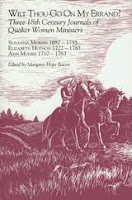
Susanna Morris from America having problems in the West Country in 1752, 'My companion and I visited all down the south parts of the west of England from Portsmouth to Land's End, though a very hilly country and bad roads, I thought it was very hard for me to get up and down the hills, for some of them were more like to stairs in an house than any other thing, and so stony that my creature threw me off many times, but (forever blessed be my great Master and preserver) I was never much hurt and sometimes not hurt at all; for the creature bowed herself so low with me that it was like laying me down and the last time it was in the soft mud.'
 |
| Catherine Payton Phillips |
Catherine Payton Phillips,
travelling from Cornwall to Bristol in 1776, ‘The weather was extremely cold
and the snow so deep that the roads in Devonshire, and thence to Bristol, had
been impassable, and were then dangerous; but through Divine favour we got
along safe, although the cold was so extreme that it was hard to bear. The road
in some places was cut through the snow, so that it looked like passing through
a deep hollow way, which had a very striking appearance.’
and lastly Joseph Wood of Yorkshire walking to a meeting at Dewsbury in 1804, 'I set out from home ye 15th. of ye. 1st. Mo. 1804 and 1st. day of the week, about 10 o clock in the forenoon being accompanied this journey by Frances Field my housekeeper. We went by Shelley, Roydhouse and Briestfield, to Dewsbury were we got betwixt 3 and 4 o.clock in the afternoon, having called to rest us twice by the way and got some refreshment we brought with us from home The roads were extremely bad and difficult owing to the very heavy rains which had lately fallen, and when we got near Dewsbury the river was much out so that in one place we should have had to have waded up to the knee had not a man kindly let us through his mill, and in another place the water was upwards of a yard deep in the road for a considerable way so that we were obliged to go through the fields on higher ground.'
 |
| Joseph Wood |
Journeys of different kinds have always been an integral part of Quakerism and physical journeys can still help to develop our own and
others’ spiritual journeys. We do not necessarily have to feel a concern to
travel in the ministry or ask or a minute from our meeting. Visiting Friends and attending meeting for
worship when away from home for our work or when on holiday can also lead to a
greater understanding of both the variety among the wider Quaker family and also
the similarity of many of our concerns. Sharing our experiences when we return to our
own meeting can also strengthen our home community.


