Showing posts with label travelling. Show all posts

Tuesday, March 26, 2019

Esther Biddle

The Execution of Charles I, 1649
Esther (or Hester) Biddle was born around 1629 and brought up in Oxford where she received a good education. She was a staunch Royalist and loyal to the Church of England. As a young woman she came to London where, she said, she sought satisfaction 'evening, morning and noonday, in the
Common Prayer' and when only one church was left open in the City she went to it. She adds, 'when their books were burned I stood for them and my heart was wholly joined to them, and when the King's head was taken off my heart and soul was burdened that I was weary of my life.'

In 1654 her life was changed when she met Francis Howgill and was convinced by him of the truth of Quakerism. In 1656 she began to travel in the ministry and to write in order to champion her new cause. She published several controversial works, some partly in verse.

Charles II c.1653
In 1656 Esther was arrested at Banbury and also at Launceston with John Stubbs and William Ames, who later went with her to Holland. In that year she also visited Newfoundland and in 1657 went to Barbados. On her return Esther had a vision of the king's restoration and went to Breda to tell Charles about it although George Fox and others had cautioned her against this course. Esther always followed her own line, which did not make her popular among Friends. During the late 1650s she spent some time in Holland and was described by her critics as a thorn in the side of Dutch as well as of English Quakers.

The Great Fire of London.
After her convincement Esther married Thomas Biddle who was also an active Friend. He was a shoemaker and seems to have had a prosperous business in London at Old Change employing a number of Quaker apprentices. This business prospered until Old Change was destroyed in the Great Fire of 1666. The family then moved south of the river but evidently never recovered their former prosperity. Shortly after Thomas's death in 1682 Esther became a pensioner of Peel Meeting and remained so for the rest of her life, at one time living in one of the rooms behind the meeting house given over to 'poor widows'. The only one of Thomas and Esther's four sons to reach adulthood was Benjamin. He was apprenticed first to his father, but after Thomas's death was re-apprenticed by Peel Meeting out of a bequest left for apprenticing sons of 'poor Friends'.

Throughout her life Esther spoke and wrote as she felt called to do without considering the consequences and was imprisoned at least fourteen times. As a widow, in spite of her poverty, Esther still managed to travel in the ministry, visiting both Scotland and Ireland during those years.

Mary II
Perhaps her most famous exploit occurred in 1694 towards the end of her life. Esther was most concerned about the war between England and France and determined, against the advice of Friends, to do something about it. She went first to Queen Mary, complained that the war with its suffering was a grief to her heart as a woman and a Christian, and asked the Queen to endeavour to end it. She then asked leave to go to France to speak to the French king on the same subject. Eventually Esther obtained a pass from the Queen's Secretary and set out. After various difficulties she came to Versailles and applied to the exiled James II, who she had met before and delivered to him the letter she had written to Louis XIV. James gave it to the Duke of Orleans who promised to pass it on to the King, but Esther was not satisfied and insisted on speaking to the King herself. 'Am I permitted to speak to the King of Kings, and may I not speak with men?' she said.

Louis XIV
When he heard about this Louis admitted Esther to his presence. She implored the King to make his peace with God and with the nations he was at war with and put a stop to 'such an overflowing and Rivulet of Blood that was shed.' The King replied, 'But woman I desire Peace and seek Peace and would have Peace, and tell the Prince of Orange so'. Having delivered her message Esther returned home. Although the war did not cease at once so that some Quakers judged her to have failed in her mission, there is no doubt that she had been faithful to her calling and her straightforwardness and fearlessness could not fail to make an impression.

Esther died in London in December 1696 at the age of sixty-seven, and was buried, probably in Bunhill Fields Quaker burying ground, having been an uncomfortable and outspoken Friend for more than forty years.


A modern view of Bunhill Fields burying ground

Thursday, March 14, 2019

Mary Alexander


Mary Alexander was born on February 7th 1760 at Needham Market, Suffolk, the third of the eight children of Dykes Alexander, a shopkeeper and mealman, and his wife Martha Biddle, of whom five survived childhood. Both her parents were established Quakers, her father being an elder and her mother a minister. Mary was fifteen when her mother died and was conscious of the possibility that she too might be called to the ministry, a calling for which she tried to prepare herself. 
The former meeting house in Needham Market, built 1704,in use as a store.

Mary lived quietly at home, caring for her father, but in 1786 he died, aged 62, and this blow was followed only nine weeks later by the death of her eldest brother Samuel’s wife, Elizabeth. The family agreed that Mary should continue to live in her father’s house with her youngest brother William, who at the age of 18 took on his father's business, while Samuel and his four children were looked after by his wife’s aunt, Mary Gurney. 

Mary Alexander struggled between her call to the ministry and her family obligations, especially after Mary Gurney also died in 1788. However confirmation of her calling came one night in 1789 when, she says, 'a light shone round my bed and I heard a voice intelligibly say “Thou art appointed to preach the Gospel”'. Mary first spoke in meeting in July 1789 and was formally recognised as a Quaker minister in 1791. 

A silhouette of Ann Tuke Alexander
Mary’s first journeys as a minister were mainly local but in 1794 she ventured further afield to Lincoln where she met and travelled with another minister, seven years younger than herself. Ann Tuke, was the daughter of William and Esther Tuke of York and became a close friend. Their friendship developed further when Ann married Mary’s brother William in September 1796. William and Ann asked Mary to live with them in the family home but she decided to find a house nearby instead. A ministerial journey in 1797 with Ann and William to Wales was continually interrupted by Mary’s illnesses. She struggled on but at Cirencester felt close to death. She dreamed that she was dead, but was sent back to life as her time had not yet come. 
Silhouette of William Alexander

Eventually at the beginning of 1798 Mary returned to Needham Market and moved into her own 'very peaceful home', but her ministerial obligations gave her little time to enjoy it. She travelled extensively with Elizabeth Coggeshall of Newport, Rhode Island, returning home at the end of 1800. For the next few years most of Mary’s travels were in her own area. She also acted as 'an affectionate nurse and attendant' to her sister-in-law Hannah, the wife of her younger brother Dykes, at the birth of their daughter, but the experience depressed her. 

William Forster
1808 brought another change in Mary’s life when her brother William and his family were forced to make a move as the family business was failing. They went to York where they were helped by Ann's family and William eventually became a successful bookseller and publisher. Mary found this 'a closely trying separation'. At the end of October 1809 Mary went, with her older sister Martha Jesup, on a religious visit to Friends’ families in Worcester. There she was joined by another minister, William Forster, with whom she attended two crowded public meetings. She was obviously ill and as soon as she had done her duty went  back to Worcester to the care of her relation Thomas Burlingham. 

At first Mary’s illness was thought to be another attack of the bilious complaint from which she had often suffered before, but it soon became obvious that she had contracted smallpox and she gradually grew worse. Her brothers Samuel and Dykes were sent for and she died surrounded by her family on December 4th 1809 at the age of 49.

Her brother William could not be with her, but he made sure that her account of her spiritual life was published two years later.


Sunday, January 01, 2017

Quaker Alphabet Blog 2015-2017 - S for Job Scott

Job Scott was born in 1751 at Providence, Rhode Island, the eldest child of Quakers John and Lydia Scott. His mother died when he was ten and from the age of fifteen he says that he got into loose company, learned to dance and delighted in playing cards. He later felt a need for religion but was more drawn to the Baptists than the Quakers. As he said, 'Friends meetings were oftener held in silence than suited my itching ear. I loved to hear words, began to grow inquisitive...and the Baptist preachers filled my ears with words and my head with arguments and distinctions, but my heart was little or not at all improved by them.'

Moses Brown
Eventually he returned to Friends, was convinced and appeared as a minister in 1774 at the age of twenty three. At this time he was employed as a school teacher and also worked as a tutor to the children of Moses Brown, whose wife had recently died. Moses came from a Baptist family but was impressed by Job's example and eventually became a Quaker. The two men worked together for the causes of abolition and peace.


In 1780 Job Scott married Eunice Anthony and the couple had six children. Job was often away from home travelling widely in the ministry and sometimes wrote encouraging poems for his wife to read while he was away. His early experience taught him to be wary of speaking too much in his ministry at home and he frequently felt himself required to give an example of silence when visiting elsewhere.

It is possible that Job also practised as a doctor, although this may have been more of an amateur interest. In a letter written at the end of his life he directs that neither of his sons should be encouraged to become physicians and that his medical books should be disposed of. He speaks with feeling of the dangers of going beyond a little general knowledge of medicine, getting out of one's depth and meddling in dangerous cases.

In 1791 his wife died and in 1792 Job felt called to travel in the ministry to Europe. At the end of that year he set sail from Boston and eventually landed in France at Dunkirk where he met with Robert Grubb, an Irish Friend. From there Job went to England, holding meetings in Kent before proceeding to London and then on to Welsh Yearly Meeting in Carmarthen. Next he went to Bristol and back to London for Yearly Meeting there.

Ballitore Meeting House
Job then travelled to Liverpool and took ship for Ireland, visiting many meetings in that country before attending the national Half Years Meeting in Dublin. He was taken ill with smallpox while staying at the house of Elizabeth Shackleton at Ballitore and in spite of all that doctors and nursing care could do he died in November 1793 at the age of forty-two and was laid to rest in the Quaker graveyard there.

A few years after his death Job Scott's edited journal of his travels in the ministry was published.  Later in the 19th century a fuller version and the rest of Job's writing was published by the Hicksites in an attempt to claim him posthumously as one of their own. The Evangelical faction certainly found Job's writing, with its emphasis on waiting in silence for the promptings of the Inward Light, unsound in doctrine. However the journal, with its reflections on the religious life and on the proper upbringing of children, was very influential and remained popular. Indeed, along with John Woolman, Job Scott is one of the few representatives of 18th century Quakerism to be found in Britain Yearly Meeting's Quaker Faith and Practice.

Monday, December 08, 2014

Quaker Alphabet Blog 2014 - W for James Wilson

James Wilson was born in 1677 in Kirby Lonsdale, Westmoreland. His father owned a 'tolerable estate' and James was brought up in the Church of England. However from his youth he was dissatisfied with what he had been taught and searched for what he called 'real religion'. He read the Bible, especially the New Testament, but eventually found what he was looking for among the Quakers.

After he was convinced James married Sarah Gardener in 1704 and they became members of Grayrigg Meeting. As well as their own numerous family they took in others including John and Samuel Fothergill who stayed with the Wilsons while attending school in Sedbergh. Later Samuel recalled that James 'discharged the office of a father to me in my minority with a father's regard and tenderness.'

When James was in her thirtieth year he became a Quaker minister and began to travel, at first locally and then farther afield. He visited Scotland and in 1714 went to Ireland. He also frequently attended Yearly Meeting in London, Wales and elsewhere.

He was not prominent nationally and wrote no journal of his travels, but he was much valued by those who knew him. His family connections with those of high rank in the district were useful to local Friends and he was of great service in settling disputes among his neighbours.

James Wilson was a good friend and neighbour as surviving letters to and from him testify. He gave good advice and encouragement, acted as a listening ear, sympathised with his friends' hardships and rejoiced with their joys. Lydia Lancaster writes to him in 1755 'with much thankfulness that I had such a friend as thee, to open my mind to and pour out my complaints...wherein thy wise counsel and tender, fatherly sympathy was a great strength to me, a poor distressed creature'. Samuel Bownas corresponded with him as a fellow minister when he was concerned about the state of Quakerism.

His old age brought much pain and infirmity but his memory and understanding did not leave him. James Wilson had outlived all his nine children and all but two of his grandchildren when he died at his home in Kendal at the end of 1769 at the age of 92.

Tuesday, May 14, 2013

Quaker Alphabet Blog Week 19 - J for Journeys


The report on my fellowship
When telling others about the path they have taken to Quakerism Friends often refer to their spiritual journey. This metaphor goes back many centuries and encompasses a great variety of stories. I have the same kind of narrative to share and this blog has been and continues to be one of the ways in which I have done and am doing that. In Quaker terms journeys have always been physical as well as metaphorical and when I travelled around the UK in 1994 as a Joseph Rowntree Quaker Fellow encouraging Friends to write and then share their spiritual autobiographies I felt that my journey continued both sides of the tradition.

 
In the 17th century one of the ways in which Quakerism was spread through the country was by pairs of travelling Friends, known as ‘the Valiant Sixty’ by Quakers and as ‘Morris-dancers from the North’ by their opponents. They were supported, financially and spiritually, by the organisation based in Swarthmoor Hall under the leadership of George Fox and Margaret Fell. On their journeys they were often welcomed and set up a network of meetings throughout England. Sometimes they were attacked and imprisoned but this often spoke for them even louder than their words and brought more to the Quaker way. Some also went further afield to Ireland, America and Europe.
Swarthmoor Hall

As Quaker practices became more established a need was felt for more regulation of Friends’ journeys. In the early 18th century a formal system of elders and overseers was set up and it became unacceptable for Friends to go on religious journeys without the approval of their meetings. A local meeting would ‘recognise’ those who it believed to have a particular gift for vocal ministry and would support them if they had a concern to travel either locally or further afield. Each minister would apply for, and usually be given, a certificate which approved a particular journey. This was to be presented to and endorsed by local Friends at each stage who would be expected to aid the traveller with hospitality and whatever other assistance was required. If a concern arose for the minister to travel further then another certificate from their home meeting was required. On their return to their own meeting  the minister would return their certificate and give an account of their journey.

As more ‘recognised’ Friends began to travel further their names were ‘recorded’ centrally in London and this practice was formalised in 1773. Recorded Ministers were also known as ‘Public Friends’ and many of them did indeed gain a national reputation, helped by the widespread publication of their journals and records of their journeys. Many of the Friends whose lives I am trying to make more widely known through my part in the Quaker Alphabet blog were Recorded Ministers and Public Friends.

During my year as a Joseph Rowntree Quaker Fellow I visited 58 groups in half the Monthly Meetings  in Britain Yearly Meeting and spoke to more than 750 people. I travelled over 9,500 miles, mostly by rail and far more comfortably than Public Friends in earlier times. They often travelled hundreds of miles by foot or on horseback on appalling roads and in dreadful weather. They crossed the Atlantic in both directions and often found themselves in uncharted territory. They suffered accidents and ill-health but were not deflected from their task. Given the conditions under which journeys were undertaken in the 17th and 18th centuries it is not surprising that the words ‘travel’ and ‘travail’ were used interchangeably!
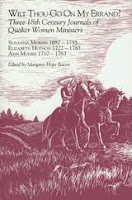
Susanna Morris's account
There are so many examples of the rigours encountered by travelling ministers on their journeys recorded in their journals that it is hard to choose between them  but here are just three. 
Susanna Morris from America having problems in the West Country in 1752, 'My companion and I visited all down the south parts of the west of England from Portsmouth to Land's End, though a very hilly country and bad roads, I thought it was very hard for me to get up and down the hills, for some of them were more like to stairs in an house than any other thing, and so stony that my creature threw me off many times, but (forever blessed be my great Master and preserver) I was never much hurt and sometimes not hurt at all; for the creature bowed herself so low with me that it was like laying me down and the last time it was in the soft mud.'
Catherine Payton Phillips
Catherine Payton Phillips, travelling from Cornwall to Bristol in 1776, ‘The weather was extremely cold and the snow so deep that the roads in Devonshire, and thence to Bristol, had been impassable, and were then dangerous; but through Divine favour we got along safe, although the cold was so extreme that it was hard to bear. The road in some places was cut through the snow, so that it looked like passing through a deep hollow way, which had a very striking appearance.’
and lastly Joseph Wood of Yorkshire walking to a meeting at Dewsbury in 1804, 'I set out from home ye 15th. of ye. 1st. Mo. 1804 and 1st. day of the week, about 10 o clock in the forenoon being accompanied this journey by Frances Field my housekeeper. We went by Shelley, Roydhouse and Briestfield, to Dewsbury were we got betwixt 3 and 4 o.clock in the afternoon, having called to rest us twice by the way and got some refreshment we brought with us from home The roads were extremely bad and difficult owing to the very heavy rains which had lately fallen, and when we got near Dewsbury the river was much out so that in one place we should have had to have waded up to the knee had not a man kindly let us through his mill, and in another place the water was upwards of a yard deep in the road for a considerable way so that we were obliged to go through the fields on higher ground.'

Joseph Wood
Journeys of different kinds have always been an integral part of Quakerism and physical journeys can still help to develop our own and others’ spiritual journeys. We do not necessarily have to feel a concern to travel in the ministry or ask or a minute from our meeting.  Visiting Friends and attending meeting for worship when away from home for our work or when on holiday can also lead to a greater understanding of both the  variety among the wider Quaker family and also the similarity of many of our concerns.  Sharing our experiences when we return to our own meeting can also strengthen our home community.