Showing posts with label May Drummond. Show all posts

Friday, April 19, 2019

Recorded ministry - some thoughts

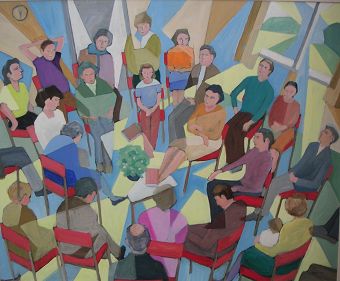
Meeting by John Perkin
I have been following the conversation about recorded ministry on social media with interest. Sam Barnett-Cormack has done a good job of summing up what has been said here and has continued the debate. As well as commenting on other posts I find that I have just a few things to add, partly from my research and partly from my own experience.

First it may be useful to look at why ministers were first recorded. This practice arose in the UK in the18th century out of a problem (as so many Quaker practices have)! There were complaints that some people had represented themselves as ministers without the backing of a meeting and were travelling around the country asking for financial support in the places they visited when some of them were not even recognised as Friends. To deal with this a system was agreed whereby if a Friend was recognised by their meeting as having a particular gift for vocal ministry then their name was sent to the Yearly Meeting in London and 'recorded' in a book so that their qualification for support could be checked.

Not all recorded ministers travelled outside their local meetings but if they were moved to do so they had to obtain a certificate from their meeting which would be quite specific about where they might go. This certificate could be presented to the Friends they were travelling among to obtain hospitality and assistance in their journey, such as the provision of a guide and a horse, the expense of which could be claimed from the meeting visited if necessary. The practice was rooted in practicality as well as answering divine inspiration.

The impetus for recognising that a minister should be recorded always came from their meeting not from themselves. This was very far from a modern job application. Being called to the ministry was not a small undertaking as it could involve very arduous travel and prolonged absences from home and many ministers' journals contain accounts of long, anxious hesitation before a calling was acknowledged. Ministers did not act alone and usually travelled with a companion, another minister or a younger Friend. They were also answerable to their meetings and to their fellow ministers, some of whom were more encouraging than others. Samuel Bownas had experienced his own difficulties and in 1750 he published a self-help book A description of the qualifications necessary to a Gospel Minister which still has things to say to us today.

There was no initial intention to mark the recorded ministers out as superior, rather as people trying to be faithful to their calling. As time went on however in some cases the respect demanded for the calling could look to others like respect demanded for the person. In the mid-eighteenth century Catherine Payton Phillips was called 'a Great Autocratrix' by the young James Jenkins, although he was hardly an unbiased observer and in the nineteenth century James Bevan Braithwaite earned the nickname of 'the Quaker Bishop'!

Eventually in the early twentieth century it was felt that meetings had come to rely too much on recorded ministers and that if they were not present then no vocal ministry would be heard. There was a movement to share the responsibility for vocal ministry more equally between all members and in the UK the practice of recording ministers was officially discontinued in 1924. Since then not only have attitudes to recorded ministers changed but so has vocal ministry itself - in length, form and content - especially among 'liberal' Friends.

Part of the problem with reviving recorded ministry is that in the past ministers were recorded for life. It was possible to withdraw approval from ministers by refusing to issue them with certificates (as happened in the case of May Drummond) but this was rare. Indeed those Friends who had been recorded before 1924 in London Yearly Meeting remained officially ministers until they died and Neave Brayshaw in his book The Quakers mentions that they were qualified to attend Meeting for Sufferings in that capacity and that some were still doing so in the late 1940s and early 1950s!

The change to limited terms (usually triennial) for elders and overseers, who were also once appointed for life, has been a good and helpful reform which I don't think anyone would wish to go back on. Perhaps the way to look at any revival of recorded ministry is through a short-term, project-based approach. The Joseph Rowntree Quaker Fellowships were set up in this way by the Joseph Rowntree Charitable Trust. When I was a fellow in 1994-1995, touring the UK with workshops on spiritual autobiography, I resisted the description of what I was doing as 'travelling in the ministry' but perhaps I was wrong to reject the label so vehemently. I was not acting entirely independently as I was answerable to the trust, who supported me financially, and I also had a support group, drawn from my meeting and more widely, who gave me spiritual and emotional support, although not a certificate!

Lastly, I have also wondered whether blogging can be a kind of ministry. Here are some thoughts on Quaker blogging which I hesitantly shared ten years ago! I have aways seen my blog as an extension of my spiritual autobiography project. Should I only have to listen to readers' comments or should I be open to discipline from the meeting or from another support group? Is there a difference between a Quaker blogging and a Quaker blog? There are a lot of questions about recorded ministry still to be considered.

Thursday, April 17, 2014

Quaker Alphabet Blog 2014 - H for Fanny Henshaw


Frances Henshaw, usually known as Fanny, was born at Caldon Hall near Leek in Staffordshire in 1714 into a wealthy family but lost both parents before she was six years old. She and her elder sister were committed to the care of their uncle as guardian, who made sure that they were well educated according to their station and placed with a serious and observant Anglican family.


A wealthy family in the 1730s
As she grew up Fanny became more and more concerned with religion and was drawn to Quakers, as she says, ‘I felt a secret love and approbation of their simplicity and godly sincerity, though I had no great acquaintance with them, nor was much conversant with their writings, neither had been at more than two of their religious meetings, and those when I was very young; but the inward sense given me of them as a people, so conscientious in the converse and commerce amongst men, kept me from prejudice against them, nor durst I, like some of my acquaintance, (though in other cases I had as quick a satirical disposition as most) make this people the subject of ridicule , nor speak lightly of the spirit they professed, feeling in the interior of my mind it would be at my own peril, if I should so daringly and imprudently indulge my wit.’


In 1734,when she was just 20, the serious illness of her sister brought about a religious crisis in Fanny, As she says ‘I was ready to petition the Almighty in the secret of my mind, that she might be relieved if it were consistent with his will, and if one of us must suffer, that it might rather be myself than she, judging myself less timorous; but in the midst of these considerations, I was informed as certainly in my own conscience, as if it had been told me by a person of unquestionable validity and authority, that I must undergo a great work, and know a thorough change before I could be prepared for a happy death. A query arising in me what this could import and what this change must be, I presently had an answer uttered to my breast with great weight and solemnity to this effect – The change is this: Thou must with others bear the Cross in the closest way, and become a Quaker.’


When Fanny told her friends they were horrified and looked for reasons for her resolution. They suggested ‘that possibly it might be the good opinion I and our family...had entertained of a neighbour of ours who had sometimes been at the house, and done many acts of friendship for us, that had biased my judgement in favour of the Quakers’ principles; he being a strict Quaker and very conscientious in his whole conduct and conversation, which I thought was praiseworthy both in him and others. But I was very far from any personal liking or affection to him, though the report was soon spread that I was in love with him.’  

Fanny's friends tried hard to change her mind by argument, enlisting the aid among others of the poet
Etching of John Byrom
John Byrom and of William Law, the author of A Serious Call to a Devout and Holy Life, who corresponded with her, but she remained firm.
After nearly two years of inward and outward struggle Fanny visited her guardian and convinced him of her sincerity and that she had come to her decision independently. As she says ‘The searcher of hearts who knew the strait I was in, wrought upon my uncle in my favour, and made him plead my cause with them that strove against me, and with a courage becoming his station, assert and plead for my just liberty of worshipping God in the way I believed to be right; saying I had as good a title to this liberty as any person, and none should abridge me of it and he stand by.’ Thus championed Fanny became a Quaker in 1736 when she was 22.

Titlepage of Law's A Serious Call
Perhaps unwisely, Fanny was recognised as a minister only a year later and began to travel extensively almost at once. All went well initially but she then encountered more opposition, this time from some Friends, because of her popularity, especially among young women. As with May Drummond, another convinced Friend, there was a fear that popularity might lead to spiritual pride.  By 1743 Fanny had reached a point of physical and mental collapse and her Quaker supporters recommended that she should be cared for by Grace Chamber of Kendal , an older woman minister who was both wise in the ways of Friends and skilled in medicine. 


Grace took Fanny into her home for an extended period, giving her rest, good advice and fresh and salt-water baths. Writing to Joshua Toft, a friend who was particular concerned about Fanny, Grace summed up the young woman's problem, ‘She has been quite overdone, both body and spirits, and the fever coming upon her in that low condition was beyond what her constitution could undergo without being borne down below measure, which is not easily recruited, there being need of both inward and outward helps. As divine providence has provided both for our souls and bodies so I conclude we ought to receive both in as much faith and thankfulness as possible we can.’


When she was on the road to recovery Grace also introduced Fanny to another young woman, Abiah
Leek Quaker Meeting House today
Sinclair, later Darby
, and the two became lifelong friends and travelled together in the ministry. Grace was instrumental in introducing Abiah, a young widow, to her second husband, Abraham Darby, and perhaps she also made a match between Fanny and William Paxton of Durham as the two couples married in the same year, 1745. Marriage and children (she and William had four sons) were good for Fanny, although she remained of a nervous disposition. The network of Quaker friendship centred on the Darby's home in Coalbrookdale also remained very important and supportive for Fanny both personally and for her Quaker ministry. Two years after William Paxton's death in 1753 Fanny married William Dodgson, also of Durham. In 1771 the family moved to Leek, Fanny's birthplace, but William died in 1775. Fanny continued to travel extensively in the ministry until she died at the home of her son William Paxton in Macclesfield in 1793 aged 78.

Fanny left a memoir of her convincement, which stresses the lack of influence which individual Quakers had on her and the strength of her Iward Guide, written partly before her first marriage and partly afterit, the two sections being signed with her different names. It was published after her death, but not without problems. According to William Phillips, the Quaker printer, writing in 1808, it was approved for publication by Second Days Morning Merting in 1794, but was suppressed by Meeting for Sufferings on the advice of William's father and Morris Birkbeck in their role as 'correctors pf the press' because of discoveries they had made 'of a certain kind of spiritual pride.' A revised version was eventually published in 1804, but this shows that doubts about the possible influence of Fanny Henshaw as a convinced Quaker remained even after many years.


Tuesday, February 19, 2013

Quaker Alphabet Week 7 - D for May Drummond


George Drummond Provost of Edinburgh
May Drummond was born about 1710 in Edinburgh. She came from an eminent family, her eldest brother George (1687-1766) being lord provost of Edinburgh six times and another brother, Alexander, consul in Aleppo. In 1731, when she was only 21, her curiosity led her to attend Yearly Meeting in Edinburgh with her society friends. Here May was convinced by the travelling minister Thomas Story. Her family were very much against her choice but she persevered and was soon recognised as a minister. She began to travel extensively in the ministry in Scotland and then, about 1735, moved to England where she created a stir among the general public.


May Drummond aged about 25

May was a tall handsome woman who spoke very eloquently and drew large crowds, on much the same scale as John Wesley, from all social classes. She was even granted an audience by Queen Caroline, which increased her fame. She was particularly appealing to young women, for whom she held special, often very emotional, meetings. A poem by ‘a young lady’ published in the Gentleman’s Magazine in 1735 gives some idea of her impact:-

          “No more O Spain! thy saint Teresa boast, 
           There's one out shines her on the British coast...                                                     
           Too long indeed, our sex has been deny’d,
           And ridiculed by mens’ malignant pride...
           That woman had no soul was their pretence,
           And woman’s spelling past for woman’s sense
           ’Til you, most generous heroine, stood forth,
           And shew’d your sex’s aptitude and worth...”


May travelled widely in England and visited Ireland in 1738 and again in 1753. Some Friends, however, distrusted her eloquence and popularity, fearing that she was in danger of acting for her own glory rather than God’s.


May Drummond
William Cookworthy (1705-1780) of Plymouth met her in 1744 and was kinder in his estimation of her. Writing to a friend he said that she was “one of a surprising genius, her apprehension being quick, lively, penetrating...a great connoisseur of the human heart in all its emotions, passions and foibles, her own open, generous, tender and humane..’Tis a strange phenomenon our young folks take a particular liking to her....I had forgotten her person which seems contrived to enforce and embellish truth, not excite desire. Her face and gesture are aimed at the mind.” He approved the religious content of her speech but was critical of her style, “rather too learned; her epithets rather swell too much. There is something too in the management and tone of her voice when she exerts it, a little too theatrical.” “But”, he adds, “I really believe all this to be owing to her education and not to any affectation or want of simplicity.”


May continued to travel but gradually more doubts were raised about her ministry. Her habit of often mentioning her noble relations and acquaintances made Friends uneasy and there was a feeling that she demanded too much attention for herself. In the late 1750s May Drummond returned to Scotland, but she was not welcomed in her own country. Edinburgh Quakers felt that she spoke in Meeting too often and refused to accept their discipline. Rumours circulated that May, having fallen upon hard times financially, had stooped to pilfering food from the houses of Friends she visited. It was also insinuated that she had become a drunkard. Eventually, in 1764, she was officially requested not to preach and her certificate as a minister was withdrawn.


May Drummond returned to England and continued to travel, becoming a shadow of her former self. Friends treated her kindly but could not acknowledge her ministry. In May 1772 she was in London, but later that year she made her way back to Edinburgh where she died aged 62. Her family forgave her sufficiently to allow her to be buried in the family vault. Her story was seen among Quakers as a fall from grace and a dreadful warning about the perils of popularity and spiritual pride, but only the impressions of others, some of them very partial and prejudiced, remain for history to assess.