Showing posts with label Catherine Payton Phillips. Show all posts

Monday, April 05, 2021

Resurrecting My Blog

Still life with books and primroses by the Finnish artist Marga Toppelius-Kiseleff. 1886  
 

Easter seems like a good time to try to put some new life into this blog again. I have written nothing for nearly two years but recently I had occasion to look back at my posts and wonder whether I could make another attempt to continue.

While many people began to write blogs and share their thoughts during the pandemic I went back to my handwritten diary and wrote much more regularly, almost daily, there. I have also spent much more time on social media, sharing daily art from my Pinterest boards on Facebook and expanding my use of Twitter to include more art, humour and even virtual friends.

The isolation of the past year has, in some ways, been easier for me than for many others. I have not been alone and my husband, the driver, has been the one to make forays into the outside world. As we are both retired we have not had any work worries as we are used to working from home on our various projects. We have adapted our routines to include many more deliveries than before and also Zoom meeetings of various kinds. We have also been able (when restrictions allowed) to see family and friends outside in various locations.

I have wondered why I did not include blog writing in my altered routine but can find no convincing answer except that I have always struggled to keep writing here and the uncertainty and fear underlying everything this last year did not improve my tendency to procrastinate!

As the seasons turn however I have found a new resolve to look again at my research into 18th century Quakers, particularly Catherine Payton Phillips, to identify gaps and fill them where I can and to do some writing with a view to publication in some form. I hope that writing here will help with that and that sharing what I write will also be of some use, both to myself and to others.

So here I go, making yet another new start. I hope to find companions on the way.

Friday, April 19, 2019

Recorded ministry - some thoughts

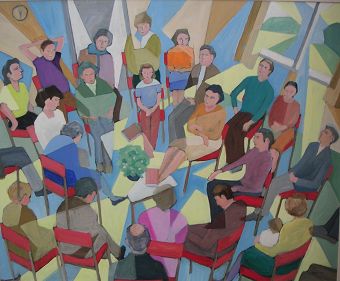
Meeting by John Perkin
I have been following the conversation about recorded ministry on social media with interest. Sam Barnett-Cormack has done a good job of summing up what has been said here and has continued the debate. As well as commenting on other posts I find that I have just a few things to add, partly from my research and partly from my own experience.

First it may be useful to look at why ministers were first recorded. This practice arose in the UK in the18th century out of a problem (as so many Quaker practices have)! There were complaints that some people had represented themselves as ministers without the backing of a meeting and were travelling around the country asking for financial support in the places they visited when some of them were not even recognised as Friends. To deal with this a system was agreed whereby if a Friend was recognised by their meeting as having a particular gift for vocal ministry then their name was sent to the Yearly Meeting in London and 'recorded' in a book so that their qualification for support could be checked.

Not all recorded ministers travelled outside their local meetings but if they were moved to do so they had to obtain a certificate from their meeting which would be quite specific about where they might go. This certificate could be presented to the Friends they were travelling among to obtain hospitality and assistance in their journey, such as the provision of a guide and a horse, the expense of which could be claimed from the meeting visited if necessary. The practice was rooted in practicality as well as answering divine inspiration.

The impetus for recognising that a minister should be recorded always came from their meeting not from themselves. This was very far from a modern job application. Being called to the ministry was not a small undertaking as it could involve very arduous travel and prolonged absences from home and many ministers' journals contain accounts of long, anxious hesitation before a calling was acknowledged. Ministers did not act alone and usually travelled with a companion, another minister or a younger Friend. They were also answerable to their meetings and to their fellow ministers, some of whom were more encouraging than others. Samuel Bownas had experienced his own difficulties and in 1750 he published a self-help book A description of the qualifications necessary to a Gospel Minister which still has things to say to us today.

There was no initial intention to mark the recorded ministers out as superior, rather as people trying to be faithful to their calling. As time went on however in some cases the respect demanded for the calling could look to others like respect demanded for the person. In the mid-eighteenth century Catherine Payton Phillips was called 'a Great Autocratrix' by the young James Jenkins, although he was hardly an unbiased observer and in the nineteenth century James Bevan Braithwaite earned the nickname of 'the Quaker Bishop'!

Eventually in the early twentieth century it was felt that meetings had come to rely too much on recorded ministers and that if they were not present then no vocal ministry would be heard. There was a movement to share the responsibility for vocal ministry more equally between all members and in the UK the practice of recording ministers was officially discontinued in 1924. Since then not only have attitudes to recorded ministers changed but so has vocal ministry itself - in length, form and content - especially among 'liberal' Friends.

Part of the problem with reviving recorded ministry is that in the past ministers were recorded for life. It was possible to withdraw approval from ministers by refusing to issue them with certificates (as happened in the case of May Drummond) but this was rare. Indeed those Friends who had been recorded before 1924 in London Yearly Meeting remained officially ministers until they died and Neave Brayshaw in his book The Quakers mentions that they were qualified to attend Meeting for Sufferings in that capacity and that some were still doing so in the late 1940s and early 1950s!

The change to limited terms (usually triennial) for elders and overseers, who were also once appointed for life, has been a good and helpful reform which I don't think anyone would wish to go back on. Perhaps the way to look at any revival of recorded ministry is through a short-term, project-based approach. The Joseph Rowntree Quaker Fellowships were set up in this way by the Joseph Rowntree Charitable Trust. When I was a fellow in 1994-1995, touring the UK with workshops on spiritual autobiography, I resisted the description of what I was doing as 'travelling in the ministry' but perhaps I was wrong to reject the label so vehemently. I was not acting entirely independently as I was answerable to the trust, who supported me financially, and I also had a support group, drawn from my meeting and more widely, who gave me spiritual and emotional support, although not a certificate!

Lastly, I have also wondered whether blogging can be a kind of ministry. Here are some thoughts on Quaker blogging which I hesitantly shared ten years ago! I have aways seen my blog as an extension of my spiritual autobiography project. Should I only have to listen to readers' comments or should I be open to discipline from the meeting or from another support group? Is there a difference between a Quaker blogging and a Quaker blog? There are a lot of questions about recorded ministry still to be considered.

Tuesday, March 05, 2019

Lydia Waring Hawksworth

Lydia Waring was the daughter of two Quaker ministers. Her father, Samuel Waring, born in 1691, was a mercer from Witney in Oxfordshire where in 1714 he married his first wife Eleanor and had three children (two daughters and a son) before she died in 1718. In 1721, when he was 30 and she was 24, Samuel married Deborah Hawkins of Alton in Hampshire and moved there. The couple had ten children, although the first two died in infancy, and Lydia, born in 1733, was the eighth of these and the fourth daughter.
Alton Meeting House, erected 1672

Samuel travelled a great deal in the ministry, mainly in the south of England, and diligently attended Yearly Meeting in London for upwards of 50 years. Deborah undertook responsibility for the care of their numerous family but she had been a minister since she was eighteen and continued her calling, mainly in the local area. Their home was a centre of Quaker hospitality and Lydia would have met many visiting Quaker ministers. It is likely that she, like her mother, received a 'guarded education' at home, learning domestic skills and reading the Bible and other approved religious texts.

It was not until she was 35, in 1768, that Lydia married Abraham Richard Hawksworth, a prosperous Bristol merchant, and moved into his house in Castle Green, the central commercial district of Bristol where many Quakers lived. In the same year Lydia's younger sister Ruth married another Bristol merchant, Thomas Rutter, so the two would have been neighbours.

Abraham was 39 when he married Lydia and by that time had become a strict Quaker, but in his younger days he had been more worldly and sociable, belonging to a Jacobite drinking club, the Nagg's Head Club, named for the tavern where it met. With maturity his interests turned to benevolent ventures, particularly for the poor and needy, and in 1766 he was appointed Treasurer of the Bristol Infirmary. Abraham was well-educated as well as wealthy and was said to understand seven languages, being much admired for his eloquence and learning.

Bristol Infirmary in 1765
Although they shared a generous disposition towards the poor, some of Lydia's friends wondered whether they were well suited. Her education was limited, although she was described as a woman of very good understanding. Her natural reserve made it difficult to get to know her and could give the appearance of pride, although her manner towards those she liked and could talk freely with was agreed to be very attractive. In the event though the marriage was cut short and the doubts of Lydia's friends became irrelevant.

Lydia and Abraham were married in February 1768 and in October Abraham contracted a fever. At first he seemed to be recovering but on October 29th he died, leaving Lydia a widow. Abraham was much mourned throughout the city and his funeral procession from Castle Green to Redcliffe Quaker Burying Ground, which was supposed to be private, passed through streets lined with mourners, their numbers at times making progress difficult. When the grave was reached, in the time of silent worship around the bier, Lydia laid her hand on the coffin and ministered publicly for the first time in a most affecting and heartfelt way.

Lydia was unexpectedly left to make a life for herself. She was now a wealthy woman with a position of independence as a widow. She had the support of family with visits to and from Alton by her mother, her sisters and other relations. She had friends in a close-knit Quaker community both locally and nationally. She also now had a position as a minister within the Society of Friends in Bristol and further afield.

Much of Lydia's travel in the ministry was as a companion and support to her old friend Catherine Payton, later Phillips. Catherine was five years younger than Lydia but had been a minister for much longer and was well known as a Public Friend. She often stayed with Lydia in Bristol both alone and with her husband William Phillips who she married in 1772.

Drawing of Catherine Payton Phillips
Catherine found Lydia 'a most tender affectionate companion' and praised her ministry, particularly in private family visits. Others might see Lydia as subservient to Catherine - James Jenkins (a critical witness) said that Catherine 'appeared as a bright star in the Heavens above us, and within the sphere of its attraction moved Lydia Hawksworth' - but the two women acted in mutual help and friendship. They had much in common. Both were brought up in Quaker families where both parents were ministers. Both were socially awkward and could give an appearance of aloofness, yet were open and affectionate to those they knew well and were loyal friends.

Lydia accompanied Catherine to Yearly Meeting in London in 1773 and again in 1775 when they spent some time resting at Alton with Lydia's newly-widowed mother Deborah. In 1776, when Deborah herself died, Lydia and Catherine travelled more extensively, to the North of England and then to Ireland.

In 1778 Lydia endured more family sorrows when her sister Ruth Rutter died at the age of 42 and she then spent much of 1779 as Catherine's companion. There are glimpses of further travels with Catherine in the following years and Lydia also attended all the local Bristol and nearby meetings. In 1783 her older unmarried sister Hannah came to Lydia's house for several months to be cared for in her last illness, dying in December. In April 1784 Lydia was so ill herself  with a 'putrid fever' that her life was despaired of, but she made a good recovery and set off for Yearly Meeting in London in May, ministering in Bristol Meeting before she went in a memorable manner.

In 1785 Lydia travelled to Truro for a meeting and then on to Redruth to stay for a rest with Catherine and William Phillips as she had done before. Unfortunately after a day or so William Phillips was taken suddenly ill and died so Lydia had to turn her energies to helping a fellow grieving widow.
Silhouette of Rebecca Jones

Back in Bristol Lydia continued to be generous to the poor and needy and to support travelling Friends, although her own health was not good. In 1788 she helped the American minister Rebecca Jones both spiritually and in practical ways. Rebecca lists 'gifts of love' which she received from Lydia including handkerchiefs, pockets, several guineas for coach and chaise hire and even an achromatic telescope costing two guineas, when a guinea then would be worth about £80 today.

However soon after Rebecca's visit in April Lydia left Bristol in failing health and went to be cared for by her older sister Deborah Townsend in London. It was here that she died of dropsy at the age of 55 in November, telling her sister, 'Don't mourn for me. I have a comfortable hope that my Heavenly Father will receive me into his kingdom.'

Lydia's will distributed her wealth between her relations and provision was also made for the poor of Bristol.  In a codicil she asks her sister Deborah to destroy all her remaining unanswered Letters of Friendship as she has no time to go through them. Lydia's body was taken back to Alton for burial so her life came full circle.
Alton Meeting House from the burial ground

Saturday, August 18, 2018

Turning Inside Out again?

For the second time a course on 18th century Quakers which I had hoped to run for Woodbrooke has been cancelled because of a lack of bookings. This has led me to consider what to do next. I am not going to abandon the 18th century but perhaps the time has come to approach it in a different way. I shall continue to try to 'introduce you to my friends' through this blog and I will look into the possibility of creating an online course for Woodbrooke for 2020.

At the same time I will put some more effort into research and writing and try to make progress on my biography of Catherine Payton Phillips. I have ideas for some journal articles which I will focus on. I know from long experience that, as the historian Barbara Tuchman put it, 'Research is endlessly seductive. Writing is hard work'. I think that now is the time to do some of that work.

Also, for a while now I have been feeling nudged towards a new direction - or rather to a new approach to an old path. It is twenty-five years since I set out as a Joseph Rowntree Quaker Fellow to give workshops on spiritual autobiography up and down the country. I talked about this in earlier posts on this blog - first of all ten years ago and then later when I was wrestling with some difficult questions.

Having published my book Turning Inside Out; an exploration of spiritual autobiography in 1996 and given up the workshops after ten years, I thought that spiritual autobiography, although still an interest, had faded into the background of my life, except in its connection to my historical research and writing.

Recently though I have been contacted by a few Friends in different parts of the country who had read my book and wanted to use it as a basis for workshops in their meetings to allow people to share their spiritual journeys. Encouraged by this I got out my notes and at long last transcribed the two background talks I gave as part of the workshops from longhand to the computer. Of course they need updating but I may now look at ways of publishing them as I originally intended to do.

I am also putting together a new Woodbrooke course with Rhiannon Grant on 'Spiritual Blogging' which is due to run in May 2019. It will be a new experience to work with someone else on different approaches to spiritual autobiography and I am looking forward to it.

I am also aware that I need to do more work on my own spiritual autobiography. I have a title - and used it for this blog - but so far I have only written fragments in different places. I was inspired by some of the writers I met at the QUIP conference earlier this year, especially Iris Graville and her memoir Hiking Naked, both to read more and to go back to writing about my spiritual journey. I need to turn inside again before I can take the next step, turn inside out and share what I have found with a wider audience.

So it seems to me that what I am being led to do is not so much a change of direction as a closer integration of the two strands of my endeavour - spiritual autobiography and 18th century Quakers. I need to allow what appear to be stumbling blocks to become stepping stones.

Thursday, March 02, 2017

Quaker Alphabet Blog 2015-2017 - V for Verses

As I said in a much earlier post, Friends in the past have felt ambivalent about both reading and writing poetry. Some, like Mary Southworth Mollineux, did write in this form but only on serious subjects and they hesitated to publish their work widely or under their own name.

In the 18th century poetry was often copied by Friends into commonplace books for their own use. This might be written by Quakers but works such as James Thomson's The Seasons were also popular. As the century progressed a few Friends ventured into the public domain with their poetry. In 1794 Catherine Payton Phillips published The Happy King; a sacred poem which was addressed to George III. The main subject of the poem is to urge the monarch to do away with slavery and was part of mainstream Quaker campaigning at this time. In her Memoirs Catherine states that when she became a minister she stopped any reading other than the Bible, but perhaps towards the end of her life she allowed herself more latitude, as her poem is very much in the contemporary style.

In later times many Friends wrote poetry and even published it, although like W. C. Braithwaite's volume it was often referred to, self-deprecatingly, as Verses. There were Quaker poets, such as the Americans Walt Whitman and John Greenleaf Whittier but it was only in the 20th century that this became an acceptable description in the UK. Poets who are Quakers do not always identify as Quaker poets but a modern anthology has recently been published. A Speaking Silence; Quaker poets of today came out in 2013 and was advertised as the first of its kind for over a hundred years.

So what is the difference between poetry and verses? Is one more serious than the other? There is certainly a continuing tradition of both forms appearing in local newsletters and blogs and both are now equally acceptable. I would like to end this post with an extract from a verse published in 2007 by the Sheffield Quaker Simon Heywood which is part of another tradition - verse which pokes fun at the idiosyncrasies of Friends - usually in a loving spirit.


I'm a lonely little Quaker
and I'm feeling very small.
I'm the clerk of Monthly Meeting
and there's no-one here at all.
I've got all the minutes drafted
and I'm ready with my pen
but the sense of Monthly Meeting
is they've stayed at home again...

If it wasn't for the Quakers
in the Quaker burial ground
then I'd be the only Quaker
for a hundred miles around,
for the buses stop at seven
and there's something on TV
and this month it's nominations
and there's no-one here but me.
I could minute they're prevented
but they never said what by.
I'm a lonely little Quaker
and I think I want to cry.

Tuesday, January 20, 2015

Quaker Alphabet Blog 2014 - Z for Zzzzz (Sleeping in Meeting)

The possibility of falling asleep during meeting for worship has been seen as something to be guarded against from the early days of the Quaker movement. As early as 1656 George Fox writes in one of his epistles, 'All Friends everywhere take heed of slothfulness and sleeping in your meetings, for in so doing you may be bad examples to others'.

One charitable excuse given by a modern commentator for being overtaken by sleep is that 'Drowsiness at these meetings may have arisen from people who led physically active lives, usually outdoors or in unheated rooms, having an opportunity to sit at ease in a room which was probably heated by a fireplace'. Perhaps another reason was that they, like the young Samuel Bownas in the late 1690s, were at meeting because it was expected of them rather than because of their own conviction.

Throughout the 18th century travelling ministers and other 'weighty Friends' urged Quakers to guard against sleep both for their own sake and to avoid giving a bad impression to others. A letter written to New Jersey Friends in 1704 advises 'Friends all take heed of sleeping, sottishness and dullness in Meetings for it is an illsavoury thing to see one sit nodding in a Meeting,and so to lose the sense of the Lord and shamefacedness both; and it grieveth the upright and watchful, that wait upon the Lord, to see such things, and for the Priests, people and others that come into your Meetings, to see you that come together to worship God and wait upon him, to have fellowship in His Spirit, for you to sit nodding is a shame and unseemly thing.’

In 1776 Catherine Payton Phillips, writing to Friends in Ireland after travelling among them, condemns drowsiness in meeting in no uncertain terms but also suggests a remedy. 'It is not improbable that the drowsiness beforementioned may, in some, proceed from eating and drinking more than nature requires; this most certainly unfits the mind for spiritual exercises; for, when the body is still, the mind sinks into rest. Under this consideration, it becomes the duty of all to watch, lest their table becomes a snare to them, and wine and strong drink be so indulged in their feasts, as to unfit them for Communion with God, and the participation of the New Wine of his Kingdom. And, young People should, especially, be careful not to indulge themselves in the use of much wine, etc. lest the prevelance of custom grow upon them as they advance in years.'

Is sleeping in meeting something which we should still worry about today? It certainly still happens as we relax in our usually well-heated meeting rooms. Indeed Ben Pink Dandelion in his 1986 book The Quakers; a Very Short Introduction states ‘In terms of the inward, studies show that Friends are engaged in many different kinds of activity, often in parallel or tandem in any one Meeting. They may be praying or praising or seeking communion or guidance, thinking or sleeping.'  

So is sleep just one of our options or should we guard against it? Perhaps if we look upon this drowsiness as a metaphor as well as an actuality it might help us to address the question. As Jacob Ritter, a 19th century minister, put it, 'Friends, we must try to keep one another awake, or else we shall lose the life. To lose the life would be losing everything; the life is more than meat, and the body than raiment.'


Tuesday, October 01, 2013

Quaker Alphabet Blog Week 39 - T for Esther Maud Tuke

Silhouette of Esther Maud Tuke
Esther Maud was born in 1727 in Westscholes near Halifax, the eldest daughter of the five children of Timothy and Ann Maud. Esther's father was a respectable Friend who worked making plush (a kind of velvet) in Bingley. However his eldest son Joseph was a wastrel whose debts led to the financial ruin of his family. Joseph eventually disappeared to America but the third son, William, showed signs of the same profligate tendencies, and his father was so worried by this that his health broke down and he died in 1752 leaving the family penniless.

On his death bed her father urged Esther to try to resolve the family's problems, and though often in despair she bravely took on this responsibility. Esther started a shop and her brother Timothy kept up his father's plushmaking business so that they could make ends meet. At this time Esther had offers of marriage but felt that she had to stay at home and help her family. She scraped together enough money to send William after his brother to America but although he prospered there he died soon after his return and his business failed. In 1763, however, the family moved to Bradford and their fortunes changed.

Esther again set up a shop and her brother Timothy qualified as an apothecary which improved his
prospects. In 1764 William Tuke, a Quaker tea merchant from York who had been a widower for four years and had five children, asked Esther to marry him. They wrote frank letters to each other telling of their past troubles and spiritual struggles and although Esther hesitated she came to feel that they would be able to understand and help one another. They were married in Bradford Meeting House in 1765 when Esther was 38 and William 32 years old.

William Tuke in old age
Esther moved into William's house in Castlegate, York, over the shop at the Coppergate end of the street. She was soon accepted by her step children, Henry, Sarah (later Grubb), William, John and Elizabeth who were aged ten, nine, seven, six and five when she married their father. It was notable that she did not treat them any differently from her own children, Samuel, who died young, Mabel and Ann. It is a testament to their affection for her that the two step children who had daughters, Henry and Elizabeth, named them Esther.


Her grandson Samuel also remembered her with affection. 'She was lively and spirited, and had a natural facetiousness which made young persons greatly enjoy her society. There was at the same time a dignity of mien and almost awfulness of character, when serious, which gave her an invincible influence over the minds of young persons.'

The family home was often opened in hospitality to visiting Friends. One visitor commented, 'They have, I fancy, no outward dependence but trade and economy; but their liberal notions are not to be described; for they and their possessions are wholly their friends.' When a weary John Woolman visited York in 1772 Esther and William's hospitality extended to finding him a quieter place to stay than their busy home in the centre of the city. When he fell ill with smallpox Esther and her daughter Sarah also shared the burden of nursing him until he died, an experience neither of them ever forgot.

Esther's gift for ministry was recognised when she was 34 and she thereafter travelled extensively in Ireland and throughout the British Isles. She often lamented what she saw as a departure from traditional Quaker testimonies and together with William was forthright in her criticisms. These views did not make either Esther or William popular in their own meeting or supported in their concerns by York Friends.

They were both concerned about Friend's education. Esther supported William when he became involved in the foundation of Ackworth and he helped her when, in 1784, she established a school at York for girls (later re-established as The Mount) and took on the voluntary superintendance of it herself. A house was taken for the school in Trinity Lane, within the city walls and William and Esther moved into it with their remaining, unmarried, family.

Also in 1784, when at Yearly Meeting the Women Friends petitioned, not for the first time, to have their own meeting officially recognised by the Mens Meeting, it was Esther Tuke who headed a deputation from the women including Martha Routh, Rebecca Jones and Catherine Payton Phillips. The story goes that 'the Clerk of the Yearly Meeting felt strongly inclined to address to her the regal enquiry of old, "What wilt thou Queen Esther, and what is thy request? It shall be given thee to the half of the kingdom" '. But in fact there was considerable doubt about whether the request would be granted and even when it was it seemed to Esther 'but the shadow of a woman's meeting' although she hoped for better in the future.

As Esther grew older she became more frail, although for a long time she continued to travel. William had a new venture to pursue in the foundation of The Retreat, a hospital for the mentally afflicted run for Friends by Friends, and Esther supported him as always. She could not take an active part but her brother Timothy was the institution's first superintendent. Esther experienced increasing difficulty in walking and was eventually unable to leave her room. Her last illness lasted only a week and she died, aged 67, attended by her daughter Mabel. William outlived her by nearly thirty years and died in 1822 when he was 89.

Esther's first words in ministry were only few, 'The just shall live by faith', but as the testimony to her states, 'From this beginning, apparently small, she was enabled to increase; and as she grew in years she was thought also to grow in faithfulness and dedication and truly attained to the state of a mother in Israel'.

Monday, September 02, 2013

Quaker Alphabet Blog Week 35 - R for Martha Winter Routh

Silhouette of Martha Routh
Martha Winter was born in 1743, the youngest of the numerous children of Henry and Jane Winter of Stourbridge, Worcestershire. She was carefully educated at home but was troubled about her religious state from an early age. Although convinced of the truths of Quakerism she found it difficult to stand by those testimonies that marked her out, in speech and dress, as different from the friends she made in the day school she attended who were not Quakers.

Around this time two Quaker travelling ministers came to visit families in her area. They reminded the children that they should not deviate from their parents' principles when their parents were not there and Martha resolved to change her behaviour and use plain speech with everyone. She wrote to  one of her best friends at school hoping that she would not be offended by the fact 'that I could not any longer give her the title of Miss, but must call her by her proper name, as well as the other girls, though I should love them no less but rather better, because I knew it was acting contrary to the mind of my parents, and the way in which friends spoke to one another.' Her schoolmates made no comment on Martha's change and treated her just the same, which greatly relieved her mind. 


Catherine Payton Phillips
From the age of fourteen Martha felt a calling to the Quaker ministry but she resisted it for many years, although some Friends were aware of her struggle. Catherine Payton Phillips, who lived locally, took a great interest in Martha and when she was seventeen recommended her for the post of assistant to Anna Coulson who had a boarding school for Friends' children in Nottingham. Eventually Martha and one of her sisters took over the running of this school.

After her father's death when she was 26 Martha's struggles with her call to the ministry affected her health and eventually became evident to all around her, although she could not confide in anyone. It was only when she was apparently at death's door that she talked to her sister and was gradually enabled to take up the burden of ministry when she was 29 years old. She began to travel in the ministry in 1775 when she accompanied Ruth Follows on a tour of the northern counties and Scotland. Martha gained much from her association with older and more experienced women Friends and in later years was glad to pass her own experience on to younger women.

In 1776 Martha married Richard Routh and the couple moved to Manchester. Richard was also a minister and the couple travelled extensively both together and separately. They had no children of their own but adopted one of Martha's nephews as a son. Unfortunately he was killed in a bathing accident while Martha and Richard were attending the Monthly Meeting at Warrington. At the time Martha told her husband, her aunt and another Friend that she knew inwardly that he was drowned, a premonition that was proved right on their return home.

Between 1794 and 1797 and from 1801 to 1805 Martha, sometimes with her husband and sometimes with a succession of female companions, was in America. In 1804 Martha came with her husband to New Bedford, Mass. with the intention of making their home there, but he died while travelling later that year in New York and she returned to England alone. Her health declined but she continued to travel and to attend the Yearly Meeting each year. In 1817 she was in London for this purpose when she was taken ill and died aged 74. She was buried in Bunhill Fields burial ground.
A Beaver Hat worn over a cap

Her experience when young led Martha Routh to adopt more moderate views than some of her contemporaries, She agreed with William Savery that in matters of dress 'no standard could be fixed, that countries differed in some small matters, but that plainness was still plainness in all places and wished Friends to keep to the true simplicity without formality.' In one matter of dress Martha even set a fashion as she is credited with the introduction of the 'plain bonnet' among American women Friends, who had until then worn beaver hats over their caps.


Tuesday, July 23, 2013

Quaker Alphabet Blog Week 30 - O for Opportunity

'Opportunity is not a lengthy visitor' says a character in Stephen Sondheim's Into the Woods but that has not always been true among Quakers!

In their journals and letters Quaker ministers often refer to their vocal ministry in meeting for worship as 'an opportunity' which they have faithfully taken advantage of. Such a meeting could be for other Quakers only or might be specially arranged in order to speak to 'the world's people.' For example Catherine Phillips visited Bath in 1750 and while there says ‘I was concerned to appoint a meeting for the strangers in town (it being the season for drinking the waters) to which some of them came, and it was a memorable opportunity, the power of truth being exalted to the reducing of their light and airy spirits, to some degree of solidity.'

Opportunities might also arise when Quakers gathered together in each others' homes. This might be done formally, when travelling ministers took on the task of visiting every Quaker family in a particular area, speaking to them individually, as couples or as whole family groups. Some ministers undertook hundreds of these visits in their travels. Informal opportunities might also occur during a social visit, often after a meal had been shared. Catherine Phillips was travelling to Yearly Meeting in Penrith in 1757 when ‘In our way we called upon that truly honourable mother in Israel, Grace Chambers, who was very ancient and had been long indisposed, with whom we were favoured with a refreshing opportunity.'

Sometimes an opportunity might arise between just two people. Ruth Follows tells the story of one of these which seemed unusual to her only because of its setting. In1783, travelling to Coalbrookdale with her friend Rebecca Reynolds, she says, ' In our travel on first-day, though much shaken with the rough and uneven road, we had a remarkably favoured opportunity, which in silence and testimony held more than two hours, and as such a season in a stage coach is not common, I thought fit to mention it.'  


These are just a few examples of Quaker 'opportunities' from the past, but do we experience anything like them today? I have known a group of Friends sitting together at a social gathering drop into a worshipful silence and I know that such 'opportunities' often happen during visits to sick or isolated Friends. Perhaps we might look upon our talks with visitors to our meeting houses, to exhibitions like the Quaker Tapestry or to events during Quaker Week as 'opportunities' too. Maybe our modern name for 'opportunity' could be another O in the Quaker alphabet - outreach?

As the quotation from Sondheim with which I began implies, opportunity has to be recognised and acted upon before it is lost for ever, and acting on it takes practice.  


Monday, June 17, 2013

Quaker Alphabet Blog Week 24 - L for letters

I could have written about Quaker letters under E for epistles but that is the official side of Quaker communication. As a historian (and, let's face it, gossip) I am more interested in the unofficial  - in letters written between friends as well as Friends - which often give a truer, because more unguarded, view of what is really going on beneath the smooth public surface.

The early organisation of the Society of Friends was based on letters. Hundreds were sent to and from Swarthmoor Hall, home of Margaret Fell and her family, giving encouragement and support both moral and financial. The majority of these letters survive in the Swarthmore manuscripts, held in Friends House Library in London. Letters were the foundation of the networks between family members and between travelling ministers at home and abroad which sustained Quakerism in the succeeding centuries.

Catherine Phillips
18th century Friends often wrote earnestly to other Friends in almost wholly religious terms. They sometimes took the time to copy out their drafts neatly, correcting spelling and adding and subtracting words and phrases, but when in a hurry this could not always be done so we are left with errors, crossings out and much more mundane post-scripts. Writing to Richard and Patience Chester in 1769 Catherine Phillips ends with the following post-script My Cousin pressed forward wth his usual diligence & speed we got to Dimchurch ye Evening we left you and he reached Home ye next day about 11 o’clock ye next morning – had I not been afraid of making him uneasy if he waited for me at Dunstable I should not have chose to have let my Frd P.C. after kindly coming to meet me have returned alone to Dunstable in a Chaise, but I saw he was in too great a hurry to be stopped ... Upon reviewing the foregoing I find that I have indeed committed many blunders but I cannot well spare time to transcribe.
In another letter, mainly about her health, to Priscilla Farmer Catherine concludes Had I strength I wd willingly put ye foregoing in a better dress but I continue very languid & weak I got to Meeting yesterday with considerable difficulty... My Love to all as due. Don’t shew any Body this scrole [scrawl].


Extract from a letter from Samuel Fothergill to Mary Pemberton
One of George Dillwyn's notebooks
It is not only historians that find these letters helpful. Letters that were particularly valued by contemporaries were frequently copied out and kept in commonplace books or journals and this may be the only form in which they surv.ive. Although it is usually the serious religious letters that are treated in this way, with any extraneous material removed, sometimes these valued letters can be quite personal.  The letter which Richard Shackleton of Ballitore in Ireland wrote to Catherine Phillips in 1757, telling her of the sudden death of her close friend and travelling companion Mary Peisley Neale just three days after her marriage, is a case in point. He begins, It’s laid on me by a common  Friend of our’s to send this Messenger of Sorrowful tidings to thee. A Scene has opened little expected by us which as I know will nearly affect thee, as it has us, I am at a Loss how to begin to relate it, and then gives a detailed account of Mary's illness and death before concluding Such was the latter and last end of our Dear Friend concerning whose excellencies I need not enlarge to thee, who not only hast been more a Witness, but art a better Judge of them than I. Catherine obviously did not keep this letter to herself as I have seen several copies in libraries on both sides of the Atlantic.


Matthew Boulton
Informal letters written by non-Quakers can also give an impression of Friends from the outside. One of the most striking examples of this that I have seen is a letter written by Matthew Boulton to his daughter about the death of William Phillips of Redruth, the husband of Catherine Phillips. Boulton knew William Phillips as a business associate as they both had mining interests in Cornwall but he obviously valued him as a man. Writing to a colleague Thomas Wilson in August 1785 he says But alas we have had a sudden & melancholy change in the death of our worthy, good, sincere, Benevolent, hospitable, Charitable, usefull, spirited, good humourd, Religious, pleasant & kind friend, William Phillips. So many adjectives witness, I think, to an unusual depth of feeling.

Today when we communicate more by email or text or through Facebook than by letter, have we lost a way of networking, of encouraging and supporting one another in the things that are eternal as well as in the everyday and of revealing ourselves as we really are?