Showing posts with label Joseph Rowntree Quaker Fellowship. Show all posts

Saturday, April 10, 2021

Waste Not, Want Not


This weekend I am spending time at the annual conference of QUIP (Quakers Uniting in Publications) as I have often done in the past. It is different this time of course as rather than travelling sometimes long distances to greet each other in person, we are seeing one another's faces on Zoom. I used to be much more involved in the running of the group than I am now so in some ways I feel more of a spectator than a participant but it is still good to connect with friends from all over the world and to meet new people too, even if only virtually.

Although I have not been writing my blog for the last year or two I have still been writing, particularly in my diary, and thinking about where to go next. I have come to a point now where I want to continue my research into Quaker history and into spiritual autobiography and life writing more generally. In order to go forward I will need to take stock, to look at what I have done and what there is still to do, to see what I can recycle and reuse from my past writings and research notes and where there are gaps I need to fill.

I joined QUIP as a publisher and 25 years ago Sowle Press (the desk-top publishing enterprise which I ran with my husband Chris) produced a book on spiritual autobiography, Turning Inside Out, based on my experience as a Joseph Rowntree Quaker Fellow. Following this I wrote and we published two collections of short biographies of Quakers through the ages - Dear Friends and Sisters (1998) and Dear Friends and Brethren (2000). I was asked about Dear Friends and Sisters at the conference yesterday but had to report that we have no stock left.

I continue to be a member of QUIP as a writer and there is a crossover in this blog between publishing and writing. I have written quite a lot of Quaker biographies here and many of them are based on pieces from Sisters and Brethren, often added to from further research. In the future I intend to continue this process and to share my researches in other ways. I do not want the work I have done and will do to be wasted so I need to remember the wise words of the historian Barbara Tuchman, 'Research is endlessly seductive; writing is hard work'.

I value my continuing connection with QUIP and the inspiration and practical help that I have received and still receive from the organisation and its members. I look forward to the rest of the conference and to conferences to come - perhaps not all of them virtual.

Saturday, August 18, 2018

Turning Inside Out again?

For the second time a course on 18th century Quakers which I had hoped to run for Woodbrooke has been cancelled because of a lack of bookings. This has led me to consider what to do next. I am not going to abandon the 18th century but perhaps the time has come to approach it in a different way. I shall continue to try to 'introduce you to my friends' through this blog and I will look into the possibility of creating an online course for Woodbrooke for 2020.

At the same time I will put some more effort into research and writing and try to make progress on my biography of Catherine Payton Phillips. I have ideas for some journal articles which I will focus on. I know from long experience that, as the historian Barbara Tuchman put it, 'Research is endlessly seductive. Writing is hard work'. I think that now is the time to do some of that work.

Also, for a while now I have been feeling nudged towards a new direction - or rather to a new approach to an old path. It is twenty-five years since I set out as a Joseph Rowntree Quaker Fellow to give workshops on spiritual autobiography up and down the country. I talked about this in earlier posts on this blog - first of all ten years ago and then later when I was wrestling with some difficult questions.

Having published my book Turning Inside Out; an exploration of spiritual autobiography in 1996 and given up the workshops after ten years, I thought that spiritual autobiography, although still an interest, had faded into the background of my life, except in its connection to my historical research and writing.

Recently though I have been contacted by a few Friends in different parts of the country who had read my book and wanted to use it as a basis for workshops in their meetings to allow people to share their spiritual journeys. Encouraged by this I got out my notes and at long last transcribed the two background talks I gave as part of the workshops from longhand to the computer. Of course they need updating but I may now look at ways of publishing them as I originally intended to do.

I am also putting together a new Woodbrooke course with Rhiannon Grant on 'Spiritual Blogging' which is due to run in May 2019. It will be a new experience to work with someone else on different approaches to spiritual autobiography and I am looking forward to it.

I am also aware that I need to do more work on my own spiritual autobiography. I have a title - and used it for this blog - but so far I have only written fragments in different places. I was inspired by some of the writers I met at the QUIP conference earlier this year, especially Iris Graville and her memoir Hiking Naked, both to read more and to go back to writing about my spiritual journey. I need to turn inside again before I can take the next step, turn inside out and share what I have found with a wider audience.

So it seems to me that what I am being led to do is not so much a change of direction as a closer integration of the two strands of my endeavour - spiritual autobiography and 18th century Quakers. I need to allow what appear to be stumbling blocks to become stepping stones.

Tuesday, May 14, 2013

Quaker Alphabet Blog Week 19 - J for Journeys


The report on my fellowship
When telling others about the path they have taken to Quakerism Friends often refer to their spiritual journey. This metaphor goes back many centuries and encompasses a great variety of stories. I have the same kind of narrative to share and this blog has been and continues to be one of the ways in which I have done and am doing that. In Quaker terms journeys have always been physical as well as metaphorical and when I travelled around the UK in 1994 as a Joseph Rowntree Quaker Fellow encouraging Friends to write and then share their spiritual autobiographies I felt that my journey continued both sides of the tradition.

 
In the 17th century one of the ways in which Quakerism was spread through the country was by pairs of travelling Friends, known as ‘the Valiant Sixty’ by Quakers and as ‘Morris-dancers from the North’ by their opponents. They were supported, financially and spiritually, by the organisation based in Swarthmoor Hall under the leadership of George Fox and Margaret Fell. On their journeys they were often welcomed and set up a network of meetings throughout England. Sometimes they were attacked and imprisoned but this often spoke for them even louder than their words and brought more to the Quaker way. Some also went further afield to Ireland, America and Europe.
Swarthmoor Hall

As Quaker practices became more established a need was felt for more regulation of Friends’ journeys. In the early 18th century a formal system of elders and overseers was set up and it became unacceptable for Friends to go on religious journeys without the approval of their meetings. A local meeting would ‘recognise’ those who it believed to have a particular gift for vocal ministry and would support them if they had a concern to travel either locally or further afield. Each minister would apply for, and usually be given, a certificate which approved a particular journey. This was to be presented to and endorsed by local Friends at each stage who would be expected to aid the traveller with hospitality and whatever other assistance was required. If a concern arose for the minister to travel further then another certificate from their home meeting was required. On their return to their own meeting  the minister would return their certificate and give an account of their journey.

As more ‘recognised’ Friends began to travel further their names were ‘recorded’ centrally in London and this practice was formalised in 1773. Recorded Ministers were also known as ‘Public Friends’ and many of them did indeed gain a national reputation, helped by the widespread publication of their journals and records of their journeys. Many of the Friends whose lives I am trying to make more widely known through my part in the Quaker Alphabet blog were Recorded Ministers and Public Friends.

During my year as a Joseph Rowntree Quaker Fellow I visited 58 groups in half the Monthly Meetings  in Britain Yearly Meeting and spoke to more than 750 people. I travelled over 9,500 miles, mostly by rail and far more comfortably than Public Friends in earlier times. They often travelled hundreds of miles by foot or on horseback on appalling roads and in dreadful weather. They crossed the Atlantic in both directions and often found themselves in uncharted territory. They suffered accidents and ill-health but were not deflected from their task. Given the conditions under which journeys were undertaken in the 17th and 18th centuries it is not surprising that the words ‘travel’ and ‘travail’ were used interchangeably!
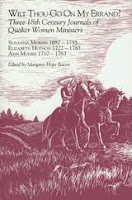
Susanna Morris's account
There are so many examples of the rigours encountered by travelling ministers on their journeys recorded in their journals that it is hard to choose between them  but here are just three. 
Susanna Morris from America having problems in the West Country in 1752, 'My companion and I visited all down the south parts of the west of England from Portsmouth to Land's End, though a very hilly country and bad roads, I thought it was very hard for me to get up and down the hills, for some of them were more like to stairs in an house than any other thing, and so stony that my creature threw me off many times, but (forever blessed be my great Master and preserver) I was never much hurt and sometimes not hurt at all; for the creature bowed herself so low with me that it was like laying me down and the last time it was in the soft mud.'
Catherine Payton Phillips
Catherine Payton Phillips, travelling from Cornwall to Bristol in 1776, ‘The weather was extremely cold and the snow so deep that the roads in Devonshire, and thence to Bristol, had been impassable, and were then dangerous; but through Divine favour we got along safe, although the cold was so extreme that it was hard to bear. The road in some places was cut through the snow, so that it looked like passing through a deep hollow way, which had a very striking appearance.’
and lastly Joseph Wood of Yorkshire walking to a meeting at Dewsbury in 1804, 'I set out from home ye 15th. of ye. 1st. Mo. 1804 and 1st. day of the week, about 10 o clock in the forenoon being accompanied this journey by Frances Field my housekeeper. We went by Shelley, Roydhouse and Briestfield, to Dewsbury were we got betwixt 3 and 4 o.clock in the afternoon, having called to rest us twice by the way and got some refreshment we brought with us from home The roads were extremely bad and difficult owing to the very heavy rains which had lately fallen, and when we got near Dewsbury the river was much out so that in one place we should have had to have waded up to the knee had not a man kindly let us through his mill, and in another place the water was upwards of a yard deep in the road for a considerable way so that we were obliged to go through the fields on higher ground.'

Joseph Wood
Journeys of different kinds have always been an integral part of Quakerism and physical journeys can still help to develop our own and others’ spiritual journeys. We do not necessarily have to feel a concern to travel in the ministry or ask or a minute from our meeting.  Visiting Friends and attending meeting for worship when away from home for our work or when on holiday can also lead to a greater understanding of both the  variety among the wider Quaker family and also the similarity of many of our concerns.  Sharing our experiences when we return to our own meeting can also strengthen our home community.

Sunday, March 08, 2009

The Ministry-Life Balancing Act

Reading Robin's post the other day got me thinking about the struggles I have had with recognising and finding ways to follow my own ministry.

It took me a long time to feel that my interest in spiritual autobiography could be seen as a kind of ministry. It was only when I moved from an academic and personal view of the subject to the development of a workshop that aimed to tell others about the form and tradition of this kind of writing and to encourage them to attempt to write their own that the thought that what I was doing was ministry entered my head.

I was 'released' to follow this ministry more intensively by a combination of the Joseph Rowntree Charitable Trust awarding me a fellowship and my employer promising that I would have a job to return to after a year. At the time, having gone through the experience of being made redundant twice, I would not have been brave enough to proceed without that safety net.

Afterwards I went back to work but also continued giving workshops and wrote an account of the fellowship. This brought me into writing and publishing both of which I now see as part of the same ministry. I know that I have been led along the path I have taken and sometimes I have been gently but firmly pushed into taking the next step. Looking back I realise that it is always when I have turned outwards, shared my experience and the experience and words of Quaker foremothers and forefathers with others, that what I have done has become ministry.

Along the way I have sometimes taken false steps. There was a time when I really wanted to find a job in the Quaker world. I thought that this would free me from having to balance my Quaker calling with other paid work. Failure and rejection were hard lessons but in time I learned from them. I remained independent and gained much from the work that did come my way. All the time I know that my Inward Teacher has been providing me with lessons that I needed to learn and has been patient with my slowness to understand.

Many years ago in meeting I was given three phrases which I understood were messages for me and not to be shared at that time. I wrote them down and they have travelled with me as lessons and encouragement in my ministry and my life. They are - 'Count your blessings' , 'A way will open' and 'My time is not your time'.

I understand more about what my ministry is and how I should express it as time goes on. Now that I have retired from paid work my view of it is slowly changing again. I am trying to be open to new possibilities but I am also continuing to write and publish, if only infrequently, here and elsewhere. God knows where I will be led next but I am still waiting to find out.

Friday, August 01, 2008

Failing to turn inside out?

Once upon a time, well in 1994 actually, I set out on a journey round Britain Yearly Meeting as a Joseph Rowntree Fellow with a project called 'What canst thou say?' I was trying to reintroduce Friends and others to the tradition of spiritual autobiography, not just as an historical exercise but as a way of sharing our different spiritual journeys with one another.

Eventually I wrote a book about the fellowship called Turning inside out, a title that expressed what for me seemed the most important part of the exercise. I was trying to encourage Friends to look inside themselves and think about their spiritual journey, then to write about it and eventually to turn the inside out and share that spiritual autobiography with others in whatever way and at whatever time seemed right for them. I also stressed that it was equally important to listen to others' stories even if they were very different from our own.

When I started out I was reacting to what I saw as a sense of isolation among British Friends and a lack of opportunity to share our spiritual journeys with one another. More than one person told me that the only time they were given such an opportunity was when they were visited after they applied for membership!

I continued giving the workshops for nearly ten years after the fellowship ended but although what I had to say was generally well received I ended with a sense of failure. It seemed to me that people were happy with the first steps, looking at their spiritual autobiography and even writing it for themselves, but that turning inside out and sharing it with others, as well as listening to others' different experience was much more difficult.

Certainly over the years the practice of spiritual autobiography has become much more widespread, particularly in America and through blogging, but I still feel that there is a problem with British Friends. Perhaps we really are more reserved and uncomfortable with personal disclosure. Perhaps it is tied up with our increasing individualism and the idea that anything goes. If we are not looking for a way to draw together and discern a way forward as a group, if we are only looking for other like-minded people to feel comfortable with, then we do not have to acknowledge our differences and can dismiss the 'other'.

When I came across the convergent conversation in the blogosphere I felt an excitement and hope that I had not felt for some time. I thought that what I had tried to do before had failed but that now perhaps what I need to do is to ask the questions of British Friends again, to encourage them to make connections in love with the 'difficult' people and beliefs in their own yearly meeting and in the rest of the Quaker world.