Showing posts with label Nottingham. Show all posts

Monday, September 02, 2013

Quaker Alphabet Blog Week 35 - R for Martha Winter Routh

Silhouette of Martha Routh
Martha Winter was born in 1743, the youngest of the numerous children of Henry and Jane Winter of Stourbridge, Worcestershire. She was carefully educated at home but was troubled about her religious state from an early age. Although convinced of the truths of Quakerism she found it difficult to stand by those testimonies that marked her out, in speech and dress, as different from the friends she made in the day school she attended who were not Quakers.

Around this time two Quaker travelling ministers came to visit families in her area. They reminded the children that they should not deviate from their parents' principles when their parents were not there and Martha resolved to change her behaviour and use plain speech with everyone. She wrote to  one of her best friends at school hoping that she would not be offended by the fact 'that I could not any longer give her the title of Miss, but must call her by her proper name, as well as the other girls, though I should love them no less but rather better, because I knew it was acting contrary to the mind of my parents, and the way in which friends spoke to one another.' Her schoolmates made no comment on Martha's change and treated her just the same, which greatly relieved her mind. 


Catherine Payton Phillips
From the age of fourteen Martha felt a calling to the Quaker ministry but she resisted it for many years, although some Friends were aware of her struggle. Catherine Payton Phillips, who lived locally, took a great interest in Martha and when she was seventeen recommended her for the post of assistant to Anna Coulson who had a boarding school for Friends' children in Nottingham. Eventually Martha and one of her sisters took over the running of this school.

After her father's death when she was 26 Martha's struggles with her call to the ministry affected her health and eventually became evident to all around her, although she could not confide in anyone. It was only when she was apparently at death's door that she talked to her sister and was gradually enabled to take up the burden of ministry when she was 29 years old. She began to travel in the ministry in 1775 when she accompanied Ruth Follows on a tour of the northern counties and Scotland. Martha gained much from her association with older and more experienced women Friends and in later years was glad to pass her own experience on to younger women.

In 1776 Martha married Richard Routh and the couple moved to Manchester. Richard was also a minister and the couple travelled extensively both together and separately. They had no children of their own but adopted one of Martha's nephews as a son. Unfortunately he was killed in a bathing accident while Martha and Richard were attending the Monthly Meeting at Warrington. At the time Martha told her husband, her aunt and another Friend that she knew inwardly that he was drowned, a premonition that was proved right on their return home.

Between 1794 and 1797 and from 1801 to 1805 Martha, sometimes with her husband and sometimes with a succession of female companions, was in America. In 1804 Martha came with her husband to New Bedford, Mass. with the intention of making their home there, but he died while travelling later that year in New York and she returned to England alone. Her health declined but she continued to travel and to attend the Yearly Meeting each year. In 1817 she was in London for this purpose when she was taken ill and died aged 74. She was buried in Bunhill Fields burial ground.
A Beaver Hat worn over a cap

Her experience when young led Martha Routh to adopt more moderate views than some of her contemporaries, She agreed with William Savery that in matters of dress 'no standard could be fixed, that countries differed in some small matters, but that plainness was still plainness in all places and wished Friends to keep to the true simplicity without formality.' In one matter of dress Martha even set a fashion as she is credited with the introduction of the 'plain bonnet' among American women Friends, who had until then worn beaver hats over their caps.


Monday, June 03, 2013

Quaker Alphabet Blog Week 22 - K for Hannah Kilham

Silhouette of Hannah Kilham
Hannah Spurr Kilham was born in Sheffield in 1774 where her father Peter was in trade. Her mother died when she was twelve, leaving her to look after her father and five brothers. Two years later her father also died and she was sent to a boarding school in Chesterfield where 'she made more rapid progress than her master approved.'

Alexander Kilham
At the age of twenty she left the Church of England for the Methodists and in 1798 became the second wife of Alexander Kilham who had split from Wesley and founded the Methodist New Connexion. However he died only eight months later at the age of thirty-six. In order to keep herself and her step-daughter Sarah, Hannah opened a day-school for girls in Nottingham. She also became acquainted with Quakers and joined the Society of Friends in 1802. At the same time she espoused the anti-slavery cause and subscribed to the abolitionist boycott of sugar. She returned to Sheffield and as well as teaching engaged in philanthropic work and originated a 'Society for the Bettering of the Condition of the Poor' that was to provide a model for many others.

Tottenham Friends Meeting House
Hannah developed a concern for African education and from 1817 studied the means of putting the unwritten languages of Africa into print so that the natives might be taught Christianity. She produced an elementary grammar for children in missionary schools in Sierra Leone. In 1819 Hannah persuaded Friends to set up an unofficial African Instruction Fund Committee with William Allen and Luke Howard among its members. She moved to Tottenham and enlisted the aid of Friends there in her cause. They visited a ship which had just arrived from the Gambian coast and asked whether any of its sailors would be willing to stay in England, be taught English and help Hannah to transcribe their languages. Two of them, Sandanee and Mahmadee, agreed to stay and Tottenham Friends raised money for their board and lodging.  From these two men Hannah acquired a good knowledge of Jaloof (Wolof) and Mandingo (Mandinka) and in 1820 published anonymously First lessons in Jaloof.

In 1823, with the backing of the Friends' committee, she sailed with the two Africans and three missionaries to St Mary's in the Gambia and taught there and in Sierra Leone. Hannah's first impression of Africa was that 'idleness was a great sin of this country which will have to be guarded against'. Later, however, after one missionary, Richard Smith, had died and her own health had suffered she revised this opinion. 'We were ourselves too closely occupied, and health in some of us consequently suffered...Now I regret that we did not more frequently urge their leaving anything undone, rather than endanger their health by so much exertion.'

Hannah returned to England in 1824 to report on progress to her committee. She criticised the colonial attitudes which even missionaries could be infected by. She said that they must learn to exert influence over merchants, not be influenced by them; they must cease using 'high tones and repelling manner' to black people. Her educational philosophy, of preserving and using indigenous languages rather than teaching English to potential converts, was most unusual for the time. She declared 'It is the Africans themselves who must be the travellers, and Instructors and Improvers of Africa.' As well as working on tracts relating to African languages and the teaching of them Hannah also spent her time at home doing what she could to help the poor of Spitalfields with education, employment and health issues. In 1826 she went to Ireland and spent some months working with the British and Irish Ladies' Society for famine relief.
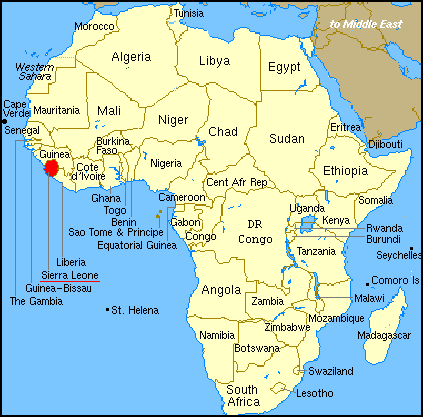
Map of Africa showing Sierra Leone, Liberia and Gambia

In 1827 she sailed again for Sierra Leone, taking with her African School Tracts which she had published in the interval. She visited Free Town and in little more than two months put into writing the numbers and principle words of twenty five languages. However poor health forced her to return home. In 1830 she set out for Sierra Leone once more. Having obtained permission from the governor to take charge of all children rescued from slave-ships she founded a large school near Charlotte, a mountain village, with the aid of a matron. Some of  the children were so emaciated as to be practically walking skeletons and Hannah later wrote that without receiving children direct from a ship she would never have understood the full vileness of slavery. Having set up the school Hannah travelled to Liberia and visited schools in Monrovia. In February she sailed for Sierra Leone but her ship was struck by lightning and put back to Liberia. Hannah did not recover from the shock and died three days afterwards at sea on 31 March 1832, aged forty eight.

Hannah Kilham's concern for Africa and her achievements in education and liguistics would be enough to make her memorable but there is another aspect to her life which should not be forgotten. The long journeys by sea which she had to make to further her concern were a particular trial to her as she suffered from a life-long dread of water. Only her conviction that it was her religious duty to go on gave her the strength to overcome her fear.

As she said, 'Why, if duty appear plain, should I recoil or draw back? I will try to be still, and hope clearly to know what is best, and not give way to any apprehension of my own creating.'