Showing posts with label Tottenham. Show all posts

Wednesday, November 20, 2013

Quaker Alphabet Blog Week 46 - W for Mary Waterhouse

Mary Waterhouse, 1871, by Samuel Lawrence


Mary Bevan (1805-1880) was the eldest child and only daughter of Paul and Rebecca (Capper) Bevan of Tottenham. Her mother died in 1817 leaving Mary, aged 12, and five young sons. In time Mary took over the role of housekeeper to her father and brothers, greatly assisted by three of her maternal aunts, Katharine Backhouse, Mary Mounsey and Sarah Harris. Mary was described as ‘of good height, graceful in figure, with perfect features and beautiful profile’ although she had a cast in her left eye (which this portrait disguises).
 

In 1825 at the age of 20 Mary began to write a spiritual journal. In it she recorded among other things her thoughts, prayers and anxieties, her precarious state of health and family matters. From it we learn that when young Mary refused several suitors and had feelings for one man which were not returned. Eventually in 1829, with the encouragement of her father who knew and did business with the family, she married Alfred Waterhouse (1798-1873) of Liverpool. He came from a large family of 6 girls and 8 boys, children of Nicholas Waterhouse, the founder of a very successful cotton broking business which most of his sons joined.

Oakfield, Aigburgh in 1848
Alfred built a house for his family at Aigburth, Liverpool, taking particular care with laying out the garden and trees. They stayed there, adding extensions as the family grew, until 1849. They had seven children who survived infancy - four sons and three daughters. 

Mary's journal tells of the growth of her family and also of her spiritual struggles. In Liverpool meeting the prosperous young woman was sometimes reprimanded for not dressing plainly enough and as a young mother had qualms herself as this extract from 1831 makes clear - At meeting yesterday for the first time since my confinement:- the beginning of it, I felt uncomfortable – being in a cloak – the colour of which I feared might offend some who would not wear such a one - & might be occasion of offence in others, who might like to imitate it. How much better to endeavour to keep to what could take the attention of none, though I did not feel condemnation on account of the colour with regard to myself, it not being one I preferred, or exactly what I intended to buy. – But of this, enough, - except that if it still occasion me uneasiness it will be better to sacrifice the cloak.

Mary and Alfred Waterhouse c 1872
Mary also struggled for many years against expressing her gift for the ministry, perhaps in part because of her fear of offending her husband, as this passage from 1836 shows - I had another distressing meeting, believing a few words were called for from me, even on my knees, & not obeying. My remorse was great, which my countenance no doubt bespoke, one of my sisters whom I saw some little time afterwards affectionately enquiring what ailed me:- I found no liberty to tell her, nor have I to mention the subject to any-one except that that evening, or before we rose the next morning, I thought it best to tell my precious husband part of what I suffered. The communication met with the reception I could not but expect from him – kindness but no sympathy, & I believe I promised to struggle against all feeling of the kind as long as I could. Alfred felt, and other weighty Friends often told him, that he should be the minister but in the end this did not happen and instead Mary was recorded a minister in 1842. 
 
Sneyd Park 1854
Alfred Waterhouse retired from business in 1847, when he was nearly 50, and having ambitions to become a farmer, looked around for a place in the country. In April 1849 the family removed permanently from Liverpool to Redland Hall, a house near Bristol, and thence in April 1850 to Sneyd Park, an imposing but damp and rather inconvenient residence in the same area where they remained for five years. As the boys were growing up they then moved to London, to 11 Cumberland Terrace next to Regents Park, so that they could attend University College School  and university.


Whiteknights House from the East
Finally in December 1858 Mary and Alfred Waterhouse moved to Reading where Alfred had purchased part of the Whiteknights estate. A new house called Whiteknights was designed and built for them by their architect son Alfred which they moved into in November 1859 and remained in for the rest of their lives. (This is now occupied by adminstrative staff of the University of Reading which eventually took over the Whiteknights site) Throughout her life Mary remained a member of the Society of Friends but her husband and children became increasingly estranged.


Alfred Waterhouse Junior
In 1864 her five youngest children were baptised into the Church of England and in 1877 Alfred junior and his family followed them.  Mary’s reaction was very like that of Elizabeth Fry – happy if she felt they were truly ‘following Christ’. Mary felt that, especially given her position as a minister, she had to stay faithful to the Society in which she had been brought up – I must stay with those who stay.


Mary was increasingly involved with her family, writing copious letters, visiting them and receiving visits, especially after Alfred junior, who had become a very successful architect (perhaps his most famous building being the Natural History Museum) built Fox Hill House, also on the Whiteknights estate, for his family in 1868. Alfred senior died while walking in his garden in 1873. After some years as a widow, cared for by her unmarried daughter Maria, Mary died in 1880 and was buried at the Meeting House in Reading.


Sunday, September 15, 2013

Quaker Alphabet Blog Week 37 - S for Thomas Shillitoe

Thomas Shillitoe
Thomas Shillitoe was born in Holborn, London, in February 1754, the son of Richard  and Frances Shillitoe, both members of the established church. Richard was employed as librarian to Grays Inn but when Thomas was twelve his father moved the family to Islington where he took over the running of the Three Tuns public house. Here Thomas was exposed to much temptation and bad company but the venture failed and the family returned to Grays Inn.

Thomas was apprenticed to a grocer at the age of sixteen but his master drank and the business failed. Finding another sober master Thomas settled down and began to attend Friends' meetings, a move which enraged his father, and, when he adopted plain dress and plain speech, was not acceptable to his master either. Thomas left his situation and hoped to live with his parents but, as he reports, his father soon told him "he would rather follow me to my grave, than I should have gone amongst the Quakers; and he was determined I should quit his house that day week, and turn out and 'quack' amongst those I had joined myself in profession with."

Gracechurch Street Meeting
At the last moment Friends found Thomas a situation in a bank where most of the clerks were Quakers. He prospered as a Friend and became a member of Gracechurch Street meeting, but his faith still brought him to uncomfortable choices. Even though some Friends advised against it, he left his job at the bank because of his conscientious scruples about buying lottery tickets for clients and trained instead as a shoemaker and tailor. Although Thomas did well at his new trade his health was not good so in 1778 he left London and moved to Tottenham, then a country village, where he found a welcoming Quaker community and also a wife, Mary Pace.

Thomas Shillitoe was subject throughout his life to severe nervous depression and anxiety. His state of mind could be 'a pit of horrors'  and he says that he was twice confined to his bed from the sudden sight of a mouse. While crossing London Bridge he would run for fear that it would collapse under him. Sometimes, for weeks on end, he believed himself to be a teapot, living in dread of anyone coming near him in case they should break him.

Rural Tottenham in a 19th century painting
Although his health improved when he moved to Tottenham he still consulted doctors about his nervous complaints for another twenty years. These medical men prescribed a diet of beefsteak with a liberal supply of wine and ale at dinner and supper. When Thomas became worse they advised him to smoke and to take spirits and water but the only effect of this was to cause him to lose sleep on top of his other ailments. For this the doctors prescribed ten drops of laudanum a day which quickly became ineffective so they increased the dose little by little until  Thomas was taking 180 drops each night!

Unsurprisingly Thomas's health did not improve and he says, 'I went about day by day frighted by fear of being frighted - a dreadful situation indeed to be living in.' Eventually, around 1800, he decided to turn his back on the doctors, rely entirely on God's help, and give up all his stimulants at once as he had found that gradually changing things did not work. He became a total abstainer and also took no animal food except milk and eggs. His health improved, although he remained of a nervous disposition. He was known for walking everywhere very fast, which may have been a healthier way of releasing his nervous energy.

As his lifestyle changed and his health improved Thomas was able to retire from business in 1806 and
devote himself to his Quaker ministry. He became a tireless campaigner for temperance before many of his fellow Quakers took up the cause and in 1808 and 1811 visited Ireland where he preached against the evils of alcohol in hundreds of whiskey shops.

Drawing of Thomas Shillitoe 1830
He also travelled extensively in the ministry at home and abroad. In 1830 he visited the continent, going to the principal towns of Holland, Denmark, Sweden, Norway, Germany, Switzerland and France. In every place he visited he went first to the prison and then to the palace and was usually well received in both establishments.

Thomas  delivered several plain-spoken addresses to British monarchs and George IV never forgot his encounter with 'that little Quaker.' Thomas went with Peter Bedford to deliver an address asking for greater public morality to William IV and his Queen. He told the Friends to whom he submitted it for inspection, 'There must be no lowering it as with water, it must be all pure brandy' - an interesting choice of words for a temperance campaigner.

Thomas Shillitoe was described as being 'below the middle height, spare, active...as if made of wire and muscle.' In 1812 he left Tottenham to be near his children, living for some time in Barnsley, Yorkshire and then for eleven years in Hertfordshire. After his continental visits in 1821 and 1825 he went to America for three years from 1826 when he was over seventy. On his return he went back to Tottenham and remained very active, living near the meeting house and regularly attending meetings there until just before his death in 1836 at the age of 82.


Monday, June 03, 2013

Quaker Alphabet Blog Week 22 - K for Hannah Kilham

Silhouette of Hannah Kilham
Hannah Spurr Kilham was born in Sheffield in 1774 where her father Peter was in trade. Her mother died when she was twelve, leaving her to look after her father and five brothers. Two years later her father also died and she was sent to a boarding school in Chesterfield where 'she made more rapid progress than her master approved.'

Alexander Kilham
At the age of twenty she left the Church of England for the Methodists and in 1798 became the second wife of Alexander Kilham who had split from Wesley and founded the Methodist New Connexion. However he died only eight months later at the age of thirty-six. In order to keep herself and her step-daughter Sarah, Hannah opened a day-school for girls in Nottingham. She also became acquainted with Quakers and joined the Society of Friends in 1802. At the same time she espoused the anti-slavery cause and subscribed to the abolitionist boycott of sugar. She returned to Sheffield and as well as teaching engaged in philanthropic work and originated a 'Society for the Bettering of the Condition of the Poor' that was to provide a model for many others.

Tottenham Friends Meeting House
Hannah developed a concern for African education and from 1817 studied the means of putting the unwritten languages of Africa into print so that the natives might be taught Christianity. She produced an elementary grammar for children in missionary schools in Sierra Leone. In 1819 Hannah persuaded Friends to set up an unofficial African Instruction Fund Committee with William Allen and Luke Howard among its members. She moved to Tottenham and enlisted the aid of Friends there in her cause. They visited a ship which had just arrived from the Gambian coast and asked whether any of its sailors would be willing to stay in England, be taught English and help Hannah to transcribe their languages. Two of them, Sandanee and Mahmadee, agreed to stay and Tottenham Friends raised money for their board and lodging.  From these two men Hannah acquired a good knowledge of Jaloof (Wolof) and Mandingo (Mandinka) and in 1820 published anonymously First lessons in Jaloof.

In 1823, with the backing of the Friends' committee, she sailed with the two Africans and three missionaries to St Mary's in the Gambia and taught there and in Sierra Leone. Hannah's first impression of Africa was that 'idleness was a great sin of this country which will have to be guarded against'. Later, however, after one missionary, Richard Smith, had died and her own health had suffered she revised this opinion. 'We were ourselves too closely occupied, and health in some of us consequently suffered...Now I regret that we did not more frequently urge their leaving anything undone, rather than endanger their health by so much exertion.'

Hannah returned to England in 1824 to report on progress to her committee. She criticised the colonial attitudes which even missionaries could be infected by. She said that they must learn to exert influence over merchants, not be influenced by them; they must cease using 'high tones and repelling manner' to black people. Her educational philosophy, of preserving and using indigenous languages rather than teaching English to potential converts, was most unusual for the time. She declared 'It is the Africans themselves who must be the travellers, and Instructors and Improvers of Africa.' As well as working on tracts relating to African languages and the teaching of them Hannah also spent her time at home doing what she could to help the poor of Spitalfields with education, employment and health issues. In 1826 she went to Ireland and spent some months working with the British and Irish Ladies' Society for famine relief.
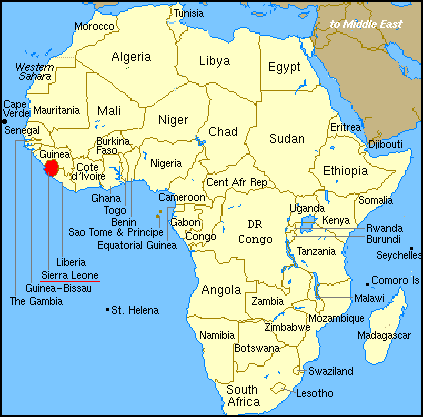
Map of Africa showing Sierra Leone, Liberia and Gambia

In 1827 she sailed again for Sierra Leone, taking with her African School Tracts which she had published in the interval. She visited Free Town and in little more than two months put into writing the numbers and principle words of twenty five languages. However poor health forced her to return home. In 1830 she set out for Sierra Leone once more. Having obtained permission from the governor to take charge of all children rescued from slave-ships she founded a large school near Charlotte, a mountain village, with the aid of a matron. Some of  the children were so emaciated as to be practically walking skeletons and Hannah later wrote that without receiving children direct from a ship she would never have understood the full vileness of slavery. Having set up the school Hannah travelled to Liberia and visited schools in Monrovia. In February she sailed for Sierra Leone but her ship was struck by lightning and put back to Liberia. Hannah did not recover from the shock and died three days afterwards at sea on 31 March 1832, aged forty eight.

Hannah Kilham's concern for Africa and her achievements in education and liguistics would be enough to make her memorable but there is another aspect to her life which should not be forgotten. The long journeys by sea which she had to make to further her concern were a particular trial to her as she suffered from a life-long dread of water. Only her conviction that it was her religious duty to go on gave her the strength to overcome her fear.

As she said, 'Why, if duty appear plain, should I recoil or draw back? I will try to be still, and hope clearly to know what is best, and not give way to any apprehension of my own creating.'