Showing posts with label education. Show all posts

Thursday, January 29, 2015

Quaker Alphabet Blog 2015 - B for William Charles Braithwaite

W.C. Braithwaite
William Charles Braithwaite was born in Camden, London on 23 December 1862, eighth of the nine children of Joseph Bevan Braithwaite and Martha Gillett. He was a pretty child, 'very fair, with a captivating smile, his golden hair arranged in one long curl on the top of his head', and was doted on by his older sisters. He showed an early love of books and learned to read when he was three.

William was brought up in a close, contented Quaker family but had little contact with others of his own age. Both his parents travelled in the ministry and were often away from home, but their absences were accepted as normal. William grew particularly close to his father with whom he shared a love of study.

William was educated at home until he was eleven when he was sent away to Quaker schools, first in Weston-super-Mare and then in Scarboroough. Leaving school at seventeen, William went to University College London, graduating in 1881. He was active in sport but also in the Bunhill Adult School and the Friends Christian Fellowship Union.

J.B. Braithwate, William's father
William next turned his attention to the law, studying mostly at home or in his father's chambers. After qualifying in 1887 William lived at home and worked for ten years with his father in his conveyancing practice at Lincoln's Inn, a happy arrangement for them both. William explored London, studied, wrote poetry and did peace work with his uncle and neighbour, George Gillett.

His friend George Newman, who met him at this time, says he was 'a reserved, imperturbable man, of quiet but exceptional power...He never failed you. He was circumspect, seeing all sides and sympathizing with many...possessing a delightful sense of humour and a well-developed faculty of imagination.'

William's life changed in 1896 when he became engaged to Janet Morland and accepted the offer of a partnership in Gillett's Bank in Banbury, Oxfordshire. He had to give up the legal profession and move away from home, but banking gave him a more settled income and more leisure for study and for his work with the Society of Friends.

Banbury Quaker Meeting House in 1910s
He settled happily in Banbury with Janet and the couple had four children, three boys and a girl. There was a shift in attitude towards family life from one generation to another. William's father had encouraged his children to join him in his study, but had expected them to do so in absolute quiet. In contrast it was a source of wonder to William's friends how he could calmly collate an ancient manuscript or prepare an Adult School lesson while his small children played around the room, asking questions and demanding his help in their games.

As well as his other interests William became involved in public life in Banbury. He was a magistrate from 1906 until his death and chairman of the Education Committee for many years. He was also very involved with the local Quaker school, Sibford.

John Wilhelm Rowntree
William was much influenced by his friendship with John Wilhelm Rowntree who he had met at Yearly Meeting 1893. They shared a belief in the need for education for Friends and for strengthening the Society and developing its ministry. One of John Wilhelm's projects was the writing of a standard history of Quakerism and he had begun collecting thousands of books and pamphlets for the necessary research when he died suddenly and unexpectedly in 1905. William took up the project and worked on it in his leisure time for the next fourteen years. He sometimes became so absorbed in the work 'that he seemed to be living in the seventeenth century, far removed from the events that were passing around him.' The Beginnings of Quakerism and The Second Period of Quakerism were completed in 1919 and have not yet been surpassed.

At the beginning of 1922 several of William's long-term projects were nearing completion. The histories had been finished eighteen months earlier, the new Yearly Meeting Book of Discipline, which William was much concerned with compiling, had been agreed and Gilletts Bank had been amalgamated with Barclays after negotiations in which William had taken a major role.

In the last week of January William ministered at Banbury Meeting, took a leading part in a conference on Ministry in Oxford, began a series of Adult School evening talks and worked in the bank. On Friday he felt unwell but went to London by the early train to attend an educational meeting. He became much worse and only just managed to get to Paddington and onto the train home. He arrived in Banbury in a state of collapse, sank into a diabetic coma and died the next day, 28 January 1922, aged fifty nine.


Thursday, June 19, 2014

Quaker Alphabet Blog 2014 - L for Learning

How do we learn about Quakers and Quakerism? The obvious answer, for me, is by reading, but when I have thought more I realise that this is far from the only way. Over the years I have certainly read a lot of books about Quakerism but also books - and diaries, letters and other less formal writings - by Quakers both past and present. Some of these have spoken to me more than others but in their variety they have built up a picture of Friends not just in 'Quaker grey' but in a whole rainbow of colours.

When I first fell among Friends I was working in Friends House Library in London  and there I learned a lot about the history and structure of the Society of Friends as well as meeting a wide range of contemporary Quakers - not always a wholly positive experience! I went to meeting for worship - at first to the brief meetings for 'staff' and later to the Local Meeting where I lived.

When I first attended Meeting for Worship in Reading I went on my own and didn't talk to anyone, going straight in to the meeting room and straight home afterwards. If anyone had approached or tried to involve me at that stage I probably would not have gone back. I thought that the worship was all I wanted or needed. Later we made a decision to go regularly as a family and it was at that point that I began to get to know people in the meeting and the way that Quakerism worked in practice. Of course I soon found myself on a committee and that was another learning experience. Working with Friends towards a common goal was not always easy but taught me a lot. I also began to go to Meetings for worship for business and saw the Quaker business method in action. Eventually I learned to take on some roles of responsibility within the meeting.

One of the first things that I had learned about Quakers was that local meetings were part of a whole structure and I have always found my experience of other meetings positive, even when difficult. Yearly Meeting, General (now Regional) Meeting and Monthly (now Area) Meeting were and are all part of my learning experience, even when things do not run smoothly. I have come a long way from the individual on a spiritual journey that I did not see the need to share with anyone else!

So have I learned about Quakers through osmosis (a long-standing excuse for not needing Quaker education)? Yes and No. It is true that sitting in meetings, getting to know individuals, working together, has not involved formal learning but I have also had a lot of things explained to me that I did not understand, and sometimes did not know that I did not understand. Eventually I became more comfortable with asking questions and am now very happy to answer other people's. Learning can come to us in many ways and the important thing I think is to be open to it whenever the opportunity arises.

Monday, June 03, 2013

Quaker Alphabet Blog Week 22 - K for Hannah Kilham

Silhouette of Hannah Kilham
Hannah Spurr Kilham was born in Sheffield in 1774 where her father Peter was in trade. Her mother died when she was twelve, leaving her to look after her father and five brothers. Two years later her father also died and she was sent to a boarding school in Chesterfield where 'she made more rapid progress than her master approved.'

Alexander Kilham
At the age of twenty she left the Church of England for the Methodists and in 1798 became the second wife of Alexander Kilham who had split from Wesley and founded the Methodist New Connexion. However he died only eight months later at the age of thirty-six. In order to keep herself and her step-daughter Sarah, Hannah opened a day-school for girls in Nottingham. She also became acquainted with Quakers and joined the Society of Friends in 1802. At the same time she espoused the anti-slavery cause and subscribed to the abolitionist boycott of sugar. She returned to Sheffield and as well as teaching engaged in philanthropic work and originated a 'Society for the Bettering of the Condition of the Poor' that was to provide a model for many others.

Tottenham Friends Meeting House
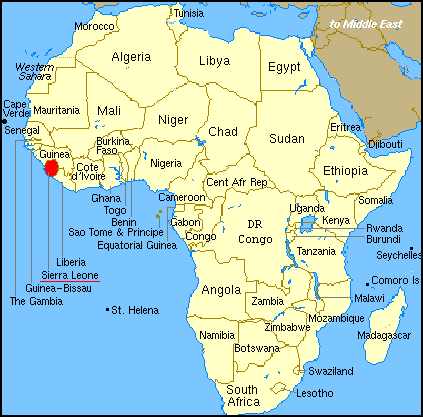
Hannah developed a concern for African education and from 1817 studied the means of putting the unwritten languages of Africa into print so that the natives might be taught Christianity. She produced an elementary grammar for children in missionary schools in Sierra Leone. In 1819 Hannah persuaded Friends to set up an unofficial African Instruction Fund Committee with William Allen and Luke Howard among its members. She moved to Tottenham and enlisted the aid of Friends there in her cause. They visited a ship which had just arrived from the Gambian coast and asked whether any of its sailors would be willing to stay in England, be taught English and help Hannah to transcribe their languages. Two of them, Sandanee and Mahmadee, agreed to stay and Tottenham Friends raised money for their board and lodging.  From these two men Hannah acquired a good knowledge of Jaloof (Wolof) and Mandingo (Mandinka) and in 1820 published anonymously First lessons in Jaloof.

In 1823, with the backing of the Friends' committee, she sailed with the two Africans and three missionaries to St Mary's in the Gambia and taught there and in Sierra Leone. Hannah's first impression of Africa was that 'idleness was a great sin of this country which will have to be guarded against'. Later, however, after one missionary, Richard Smith, had died and her own health had suffered she revised this opinion. 'We were ourselves too closely occupied, and health in some of us consequently suffered...Now I regret that we did not more frequently urge their leaving anything undone, rather than endanger their health by so much exertion.'

Hannah returned to England in 1824 to report on progress to her committee. She criticised the colonial attitudes which even missionaries could be infected by. She said that they must learn to exert influence over merchants, not be influenced by them; they must cease using 'high tones and repelling manner' to black people. Her educational philosophy, of preserving and using indigenous languages rather than teaching English to potential converts, was most unusual for the time. She declared 'It is the Africans themselves who must be the travellers, and Instructors and Improvers of Africa.' As well as working on tracts relating to African languages and the teaching of them Hannah also spent her time at home doing what she could to help the poor of Spitalfields with education, employment and health issues. In 1826 she went to Ireland and spent some months working with the British and Irish Ladies' Society for famine relief.
Map of Africa showing Sierra Leone, Liberia and Gambia

In 1827 she sailed again for Sierra Leone, taking with her African School Tracts which she had published in the interval. She visited Free Town and in little more than two months put into writing the numbers and principle words of twenty five languages. However poor health forced her to return home. In 1830 she set out for Sierra Leone once more. Having obtained permission from the governor to take charge of all children rescued from slave-ships she founded a large school near Charlotte, a mountain village, with the aid of a matron. Some of  the children were so emaciated as to be practically walking skeletons and Hannah later wrote that without receiving children direct from a ship she would never have understood the full vileness of slavery. Having set up the school Hannah travelled to Liberia and visited schools in Monrovia. In February she sailed for Sierra Leone but her ship was struck by lightning and put back to Liberia. Hannah did not recover from the shock and died three days afterwards at sea on 31 March 1832, aged forty eight.

Hannah Kilham's concern for Africa and her achievements in education and liguistics would be enough to make her memorable but there is another aspect to her life which should not be forgotten. The long journeys by sea which she had to make to further her concern were a particular trial to her as she suffered from a life-long dread of water. Only her conviction that it was her religious duty to go on gave her the strength to overcome her fear.

As she said, 'Why, if duty appear plain, should I recoil or draw back? I will try to be still, and hope clearly to know what is best, and not give way to any apprehension of my own creating.'