Wednesday, May 31, 2023

A way forward


In the Library. Thomas Pole. 1806

I have been giving some thought to what effect Britain Yearly Meeting 2023 has had on me.

I have been going to Yearly Meeting now, fairly regularly, for nearly 50 years. Sometimes it has been inspiring, sometimes difficult, even depressing, but I have kept on going as I always find something there to feed my spiritual life.

This time I found that, beginning with the introduction on the Book of Discipline Revision by Rosie Carnall, I was often reminded of my good intentions which I had not followed up on. I meant to send in possible extracts to the committee, particularly from the 18th century which is woefully under-represented at the moment - but I have not got round to doing it.

As I listened to Rosie - and to William Penn - the words of the pragmatic 18th century Quaker John Bellers came into my mind. In 1714 he said 'He that doth not write whilst he is alive can’t speak when he is dead.' Death is always a possibility but at 75 years old it feels closer than it once did. I have researched extensively and given talks and workshops on spiritual autobiography and 18th century Quakers. I have written blog posts on a variety of Quaker subjects but increasingly infrequently.

Sitting in the Yearly Meeting sessions I had an experience I have had before, an inward 'voice' prodding me, pushing me forward, repeatedly reminding me that I must write. If not now, when? I must send extracts to the Revision Committee. I must get on with my 18th century researches and put them into some order. I must write and even publish - articles or even a book - and I must come back to this blog.

So I have made a start by sitting down at my computer and returning to the work of transcribing the 18th century letters which I photographed in Friends House Library many months ago. Once that is done I hope I will see where to go next.

It was becoming clear to me before Yearly Meeting that I needed to step back from the many Quaker roles which I had undertaken and by the end of this year I will have let most of them go. At first I could not see a way forward from this but after Yearly Meeting I do. What I am working on may seem to others too personal, irrelevant to the wider world, but I have a sure sense that this is the path that I am being led, or 'pushed', to take. I will try to be faithful to that leading.


Friday, May 27, 2022

No More Quaker Heroes - or Villains

  A Book of Quaker Saints by Lucy V. Hodgkin

  illustrated by F. Cayley-Robinson


A Yearly Meeting preparation session on 'Uncomfortable Quaker Histories' which I attended on Zoom yesterday allowed me to revisit work I have done myself on challenging Quaker myths and legends and got me thinking about how to take this forward.

We were presented with stories of Quakers in Lancaster and in America (including William Penn) who had been profitably engaged in the Atlantic slave trade and who had not always been challenged effectively by their contemporaries. We were also reminded of the ambivalent attitude of some Friends in the past to the poor - only to be helped if they were suitably grateful and knew 'their place' and never wholly accepted as equals. In this context we were asked if a testimony to equality had ever existed.

Back in the 1980s I gave a series of talks on Quaker Myths and Legends, questioning assumptions that were taken for granted at the time such as equality between men and women and how the peace testimony came about. In 1986 I was part of the group who wrote and presented the Quaker Womens Group Swarthmore lecture 'Bringing the Invisible into the Light'. As well as questioning whether equality had always been an integral part of the Society of Friends, the lecture included examples of painful personal experience such as domestic violence among Friends. The lecture was welcomed by many but also provoked very strong negative reactions - disbelief that Quakers could act in this way and denial that Friends were not always perfect in their relations with others. A lot of the discomfort stemmed from our audacity in challenging some Friends' established world view.

We are now looking at our past again through the lens of sexism, racism and classism and what we are finding is uncomfortable. I would say that this is what an honest study of the past should be. There never were Quaker Saints. Quakers have always been humans with human imperfections, shaped by the wider society they found themselves in but also by changes in the practices and attitudes of the Society of Friends through the centuries. I think it is better and more helpful to identify with past Quakers who were not perfect than to put heroes and heroines on a pedestal from which they may come crashing down. We may feel shame at the actions of Friends in the past and seek in some way to make amends but I believe that we should also try to reach for understanding, to learn where we are going wrong now and how we may change and improve.

We may remove the name of William Penn from a room in Friends House but I hope we can continue to give him his due and not reject him totally as a Quaker villain. We should not reject his writings because of some aspects of his life because his words are still valuable. When my meeting was reading through Quaker Faith and Practice several years ago as part of the revision process I was surprised to find that the extracts Friends found most helpful were not the most modern writings but those by William Penn and Isaac Penington. 

We need meticulous research, such as we were presented with in the preparation session, looking in detail at Quaker links to slavery, attitudes to the poor and other marginalised groups. The more we learn the more we can understand rather than only condemn. Local studies are a good start but these themes also need to be seen in a wider context - for example the way in which womens' meetings evolved, their purpose and their influence.

I have tried in my biographical posts on this blog to include a broad range of past Quakers, including women of course but also lower class Quakers without much money. There are also 'difficult' Friends and those with mental health problems. Just a few examples are Ruth Follows, Thomas Shillitoe, Benjamin Lay and his wife Sarah, Josiah Langdale and Rebecca Jones. James Jenkins was trying to write honest rather than idealised testimonies to Friends he had known in the 18th century, There is much more work to be done to bring invisible poor Quakers, Quaker servants and Quaker people of colour into the light, but a start has been made.

If there is one lesson we can learn from the past it is that there should be no more Quaker Saints. We must do away with Quaker heroes but I hope we will not go to the other extreme and cast Friends as villains. Idealising the past makes us unable to face reality but so does seeing it only in black and white rather than in Quaker gray.
.

Sunday, January 09, 2022

Here I go again!

Woman at a window. Jacobus Vrel. 1654

In April last year I decided to try to resurrect this blog. I had good intentions but I only managed three posts in 2021, all in April!

Over the years I have often had problems with writing regularly here although, as I said last year, I have been writing regularly elsewhere. I think perhaps that a blog post feels like a substantial piece of writing - and certainly my historical posts do require quite a bit of research - so that I often feel too intimidated to begin.

With the beginning of a new year I feel inspired to try again, but not to be too hard on myself. I will aim to write once a month (or 12 times a year) and I will broaden my range of topics. Sometimes, as I am doing now, I will just sit down and write and see what comes. I will write about Quakers and Quaker history but may change my format. I hope to share some passages of Quaker writing that have helped me and may even suggest passages to the Book of Discipline Revision Committee! I may also share other passages that I have written in my commonplace book over the years.

Another way in which I hope to continue with this blog is through visual images. Over on Facebook I have been sharing art from my Pinterest boards each day without comment. Perhaps here I can comment about the art, the artist and what the image means to me.

I have good intentions but I have had those before and not written. Let's see how I get on in 2022!


Tuesday, April 13, 2021

Robert and Mary Jane Catlin Davidson - Quaker missionaries to China


China missionaries on the Yangtze river. Quaker Tapestry panel B7, Service Overseas.


Robert Davidson was born in 1864, the eldest of the six surviving sons of Adam and Mary Davidson of Hillsborough, near Lisburn in Northern Ireland.

Robert's father had served as a soldier in China but had found himself unable to continue to subdue the heathen rather than reach out to them as fellow human beings. He declared himself a pacifist, was discharged from the army and sent back to Ireland where he became a Quaker. He supported his family by opening a grocery shop but also held mission meetings to which people flocked from miles around. Adam wanted to go back to China but bad health and lack of education prevented him so he urged his eldest son to go in his place. 'Go to China', he told Robert, 'and as you meet the Chinese tell them that you come with the Bible and not with a gun, as I mistakenly did.'

Robert (centre) with mother Mary
and brothers Warburton, Alfred and Asher, 1886

Robert was educated at the Friends School in Lisburn until he was fourteen when lack of money forced him to leave and earn his living in a linen factory. His father's words had given him a goal however and when he was nineteen he wrote to the Friends Foreign Mission Association (FFMA) in London asking them to send him to China as a missionary. Friends were hesitant about sending someone so young, uneducated and inexperienced on such a hazardous posting but Robert was insistent and persuaded Henry Stanley Newman of FFMA to visit his father. Henry was impressed and when Adam died in 1885 it was in the knowledge that his son had been accepted for service.

Robert came to London for his training in mission work, an ad hoc course of study designed to fill the gaps in his general education and to give him a basic knowledge of theology, church history, book-keeping and carpentry as well as a three-month elementary medical course. He spent his evenings at the Friends Mission Hall in Hart's Lane in Bethnal Green where his temperamental suitability for mission work could be tested and he threw himself into this with vigour. 

It was also at Hart's Lane that Robert met one of the senior workers Mary Jane Catlin. Ever since she was a child Mary Jane had wanted to go overseas as a Quaker missionary. Remaining at home to look after her invalid mother, she threw her considerable energies into any opportunity for service that came her way. She started adult schools and self-help societies for the London poor, set up and ran convalescent and childen's homes at the seaside at Folkestone and Worthing and qualified as a nurse. At the same time she acted as secretary for innumerable Quaker committees. She later said that during those years she was known for her bag, her bonnet and her Bible.

In spite of the age difference between them Robert and Mary Jane's shared interests and enthusiam brought them together and in July 1886, when he was 22 and she was 39, they married and in September set out together for China.

Eventually they made their way to Szechwan, West China where they arrived in May 1887. They made the hazardous journey from Shanghai 1000 miles up the Yangtze River to Ichang and then 500 miles through the gorges, the boats pulled by trackers with bamboo rope. They studied the Chinese language and customs and developed the Friends Mission against considerable odds through medical and educational as well as evangelistic work. Mary Jane used her nursing and midwifery skills as well as her organisational and administrative abilities to assist Robert and to work herself among Chinese women. They had one son, Robert, known as Robin, born in 1889.

Teapot from Horniman collection
As Quaker missionaries Robert and Mary Jane were allowed to return to Britain from time to time on furlough but it was not until late 1894 that they and their son managed to do this for the first time. They stayed for nearly two years, resting and visiting friends and family but also making direct contact with the China Committee of FFMA and speaking at Quaker meetings throuhout Britain and Ireland. They put on exhibitions of Chinese artefacts and sometimes dressed in Chinese costume. Six-year-old Robin also played a part, demonstrating how to eat with chopsticks and reciting a prayer in Chinese. Before they returned to China Robert and Mary Jane visited the Horniman Museum and talked to Frederick Horniman, himself a Quaker, who bought more than 300 items from their collection which remain in the museum to this day.

The Davidson brothers, 1902, Henry, Warburton, Alfred and Robert
As well as drumming up support for the mission in money and prayers Robert and Mary Jane also hoped for missionary recruits but in this their success was limited. In fact their greatest success was in recruiting their own family, with Robert's brother Warburton arriving in 1898 followed by two more brothers, Alfred and Henry in 1901. In time Robin Davidson brought his bride to China and they too became part of the mission.

In January 1918 Mary Jane died suddenly and unexpectedly of pneumonia at the age of 70. Her daughter-in-law Kathleen wrote, 'There is no fearfulness, no ugliness, no horror in her death. She was wonderful. The order of her house, her accounts, and all she possessed surpasses anything I ever thought of. She must have always been prepared to go.'

Mary Jane and Robert at Szechwan YM, 1916

Four years later Robert married an American colleague, Pearl Page. In his later years he became a lecturer at the West China Union University which he and his brothers had helped to found. When he retired in 1925 he was asked to take on the headmastership of the Friends School in Brummana, Lebanon, where he stayed for five years. 

In 1932 Robert finally retired and settled on the south coast of England in Bournemouth, where his meeting much appreciated his help with young people and his service as an elder. He was far from idle, taking on the secretaryship of the Christian Universities in China Council and of the China Committee of Friends Service Council (which had taken over the work of FFMA). Although his health prevented him from taking up the many invitations he received to return to China he attended many international meetings and it was while he was at one of these in California that Robert died of heart failure at the age of seventy-eight.

Saturday, April 10, 2021

Waste Not, Want Not


This weekend I am spending time at the annual conference of QUIP (Quakers Uniting in Publications) as I have often done in the past. It is different this time of course as rather than travelling sometimes long distances to greet each other in person, we are seeing one another's faces on Zoom. I used to be much more involved in the running of the group than I am now so in some ways I feel more of a spectator than a participant but it is still good to connect with friends from all over the world and to meet new people too, even if only virtually.

Although I have not been writing my blog for the last year or two I have still been writing, particularly in my diary, and thinking about where to go next. I have come to a point now where I want to continue my research into Quaker history and into spiritual autobiography and life writing more generally. In order to go forward I will need to take stock, to look at what I have done and what there is still to do, to see what I can recycle and reuse from my past writings and research notes and where there are gaps I need to fill.

I joined QUIP as a publisher and 25 years ago Sowle Press (the desk-top publishing enterprise which I ran with my husband Chris) produced a book on spiritual autobiography, Turning Inside Out, based on my experience as a Joseph Rowntree Quaker Fellow. Following this I wrote and we published two collections of short biographies of Quakers through the ages - Dear Friends and Sisters (1998) and Dear Friends and Brethren (2000). I was asked about Dear Friends and Sisters at the conference yesterday but had to report that we have no stock left.

I continue to be a member of QUIP as a writer and there is a crossover in this blog between publishing and writing. I have written quite a lot of Quaker biographies here and many of them are based on pieces from Sisters and Brethren, often added to from further research. In the future I intend to continue this process and to share my researches in other ways. I do not want the work I have done and will do to be wasted so I need to remember the wise words of the historian Barbara Tuchman, 'Research is endlessly seductive; writing is hard work'.

I value my continuing connection with QUIP and the inspiration and practical help that I have received and still receive from the organisation and its members. I look forward to the rest of the conference and to conferences to come - perhaps not all of them virtual.

Monday, April 05, 2021

Resurrecting My Blog

Still life with books and primroses by the Finnish artist Marga Toppelius-Kiseleff. 1886  
 

Easter seems like a good time to try to put some new life into this blog again. I have written nothing for nearly two years but recently I had occasion to look back at my posts and wonder whether I could make another attempt to continue.

While many people began to write blogs and share their thoughts during the pandemic I went back to my handwritten diary and wrote much more regularly, almost daily, there. I have also spent much more time on social media, sharing daily art from my Pinterest boards on Facebook and expanding my use of Twitter to include more art, humour and even virtual friends.

The isolation of the past year has, in some ways, been easier for me than for many others. I have not been alone and my husband, the driver, has been the one to make forays into the outside world. As we are both retired we have not had any work worries as we are used to working from home on our various projects. We have adapted our routines to include many more deliveries than before and also Zoom meeetings of various kinds. We have also been able (when restrictions allowed) to see family and friends outside in various locations.

I have wondered why I did not include blog writing in my altered routine but can find no convincing answer except that I have always struggled to keep writing here and the uncertainty and fear underlying everything this last year did not improve my tendency to procrastinate!

As the seasons turn however I have found a new resolve to look again at my research into 18th century Quakers, particularly Catherine Payton Phillips, to identify gaps and fill them where I can and to do some writing with a view to publication in some form. I hope that writing here will help with that and that sharing what I write will also be of some use, both to myself and to others.

So here I go, making yet another new start. I hope to find companions on the way.

Tuesday, June 18, 2019

Firbank Fell anniversary meeting - Ann Newby Audland Camm

Fox's Pulpit
This is the text of a talk I gave at the 2019 annual meeting to mark the anniversary of Fox speaking on Firbank Fell in 1652. It should have been delivered near the spot known as Fox's Pulpit but because of heavy rain was relocated to Briggflatts meeting house nearby.

When does a movement begin? One reckoning dates the beginning of Quakerism from the day, June 13th 1652, when George Fox spoke to a large gathering here on Firbank Fell, but he had been gathering support and supporters before that date and continued to do so. Perhaps the setting up of an organisation spreading from Swarthmoor Hall and the fell family, who he was yet to visit, is a more effective beginning?

I want to talk today about someone who may or may not have been here that day, although her husband certainly was. Someone who lived long enough to see great changes in the movement that began in 1652 and who outlived many of its founders, including George Fox.

Ann Newby was born in Kendal in 1627. When she was twelve years old she went to London to live with an aunt for seven years before coming home to Kendal. She went into service with a well-to-do family in York but when her mistress died she returned to Kendal. She was concerned about her spiritual life and joined a group of Seekers of which John Audland was a member. They married when she was 23 and he was 20. They both thought that they had found their spiritual home until they encountered George Fox.

John Audland was here that day as he and Francis Howgill were preaching in Firbank chapel in the morning. Ann may have been part of the crowd but she certainly met Fox when he stayed in their house. He also stayed with John Camm and his wife Mabel and perhaps made as much of an impression face to face as he did preaching for three hours in the open air!

For John and Ann Audland convincement did not come easily as it overturned everything they were sure of. Ann reports of her husband,
'He was high in Notion and Profession, imagining that he had been filled with durable Riches and Wisdom; but in the Light of this Day he saw the emptiness of it all, while he wanted the Substance, Life in the eternal Word, and by the same to be sanctified throughout. Therefore under the sense of this great want, many and great were his Sighs and Groans and his Tears not a few; Days and Nights of Sorrow many an one he underwent, the Word and Power of the Lord being as a Fire revealed within him, to burn the great building, that he had been erecting and setting up of Hay, Wood and Stubble; and in this exercise I also had a share with him, and in great Lamentation I have heard him often sorrowfully say; "Ah! what have we been doing? What have we been labouring for? or what availeth our great Profession? all our building tumbles down!"'

Once they were convinced they could not remain at home but set out two by two as 'morris dancers from the North'. John Audland travelled with John Camm to Lancashire, Cheshire, Oxford, the Welsh Marches and, perhaps most notably, Bristol. Ann Audland travelled with Mabel Camm to Auckland in Durham and then to Banbury where they were imprisoned for more than a year. Ann also travelled to Launceston in Cornwall to visit George Fox in prison.

The travelling and the rough treatment they encountered took its toll. John Camm died in 1657 of consumption made worse by the rigours of his ministry. Mabel Camm died not long after. In 1664 John Audland died of a fever, leaving his wife Ann with a small daughter and heavily pregnant with a son who was born only a few days after his father's death. So of the four travellers only Ann was left. She continued on and in 1666 she married Thomas Camm, John and Mabel's son and fourteen years her junior, who had himself been convinced by Fox as a twelve year old boy in Preston Patrick chapel.

Camsgill today
They lived at Camsgill, the house that John Camm had built in 1647, and were both active in the Quaker cause. Thomas travelled extensively and was also fined more than thirty times for refusing tithe payments. Of the forty years of their marriage Thomas spent nine in prison - six years in Appleby and three in Kendal. Ann did not travel during her second marriage but continued to speak, to petition and to support her meeting as a minister and a 'mother in Israel'. She was also a 'powerful fellow-labourer' with her husband.

She might sometimes 'be grieved' when women friends spoke too hastily or unseasonably in large meetings and she might reprove them for it, but that did not mean that she was actively discouraging. She herself was careful about when to appear in public in preaching or prayer 'but when she did it was fervent, weighty and with the demonstrating of the spirit, and with power' - the same power that she had felt and expressed from her first convincement.

After the Restoration Friends concentrated more on organisation and discipline. Fox established separate womens' meetings for business to encourage women to take a full part in the Quaker movement, to be helps-meet and equal labourers in the vineyard. Ann pursued her Quaker path by encouraging women to be faithful in their attendance and ministry in these meetings.

Ann was also a fierce critic of John Wilkinson and John Story, two Westmoreland Friends who opposed womens' meetings, as well as advising Quakers not always to meet in public but to hold safer, private meetings. The two men had also refused to go to John Audland's aid in Bristol in the 1650s and Ann had neither forgotten nor forgiven that. John Story was dismissive of women Friends who defended their right to hold womens' meetings and to preach, telling them to stick to washing dishes and sending them crying home.

Ann spoke out against Wilkinson and Story whenever she could. In 1675 the Kendal Womens Meeting wrote to another womens' meeting, the Box Meeting in London, 'Our meetings are lightly looked upon and of little esteem among some who should have strengthened us' (i.e. Wilkinson and Story) and Ann Camm was a signatory of that letter.

As Ann grew older she continued on her faithful path, supporting her husband and family, encouraging and directing other women Friends and never forgetting the revelation that had come to her and so many others that day on Firbank Fell. She died in November 1705 'in a good Old Age being in her 79th year, as a Shock of Corn in Season...and was Honourably buried, many Ancient Friends of about thirteen adjacent Meetings Accompanied her to the grave.'

Ann Camm was a survivor and her spiritual journey went through changes in emphasis over time, as the movement which she had been part of starting also changed - as it would change again and is still changing. Faithfulness to the truth is what is important, but that faithfulness can mean different things at different times. There are many different paths that can lead to a vibrant Quakerism for today.

Friday, April 19, 2019

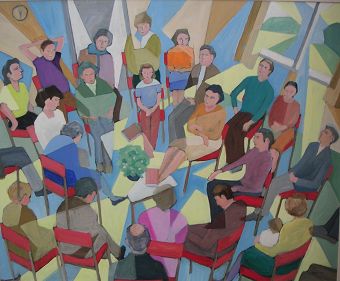
Recorded ministry - some thoughts

Meeting by John Perkin
I have been following the conversation about recorded ministry on social media with interest. Sam Barnett-Cormack has done a good job of summing up what has been said here and has continued the debate. As well as commenting on other posts I find that I have just a few things to add, partly from my research and partly from my own experience.

First it may be useful to look at why ministers were first recorded. This practice arose in the UK in the18th century out of a problem (as so many Quaker practices have)! There were complaints that some people had represented themselves as ministers without the backing of a meeting and were travelling around the country asking for financial support in the places they visited when some of them were not even recognised as Friends. To deal with this a system was agreed whereby if a Friend was recognised by their meeting as having a particular gift for vocal ministry then their name was sent to the Yearly Meeting in London and 'recorded' in a book so that their qualification for support could be checked.

Not all recorded ministers travelled outside their local meetings but if they were moved to do so they had to obtain a certificate from their meeting which would be quite specific about where they might go. This certificate could be presented to the Friends they were travelling among to obtain hospitality and assistance in their journey, such as the provision of a guide and a horse, the expense of which could be claimed from the meeting visited if necessary. The practice was rooted in practicality as well as answering divine inspiration.

The impetus for recognising that a minister should be recorded always came from their meeting not from themselves. This was very far from a modern job application. Being called to the ministry was not a small undertaking as it could involve very arduous travel and prolonged absences from home and many ministers' journals contain accounts of long, anxious hesitation before a calling was acknowledged. Ministers did not act alone and usually travelled with a companion, another minister or a younger Friend. They were also answerable to their meetings and to their fellow ministers, some of whom were more encouraging than others. Samuel Bownas had experienced his own difficulties and in 1750 he published a self-help book A description of the qualifications necessary to a Gospel Minister which still has things to say to us today.

There was no initial intention to mark the recorded ministers out as superior, rather as people trying to be faithful to their calling. As time went on however in some cases the respect demanded for the calling could look to others like respect demanded for the person. In the mid-eighteenth century Catherine Payton Phillips was called 'a Great Autocratrix' by the young James Jenkins, although he was hardly an unbiased observer and in the nineteenth century James Bevan Braithwaite earned the nickname of 'the Quaker Bishop'!

Eventually in the early twentieth century it was felt that meetings had come to rely too much on recorded ministers and that if they were not present then no vocal ministry would be heard. There was a movement to share the responsibility for vocal ministry more equally between all members and in the UK the practice of recording ministers was officially discontinued in 1924. Since then not only have attitudes to recorded ministers changed but so has vocal ministry itself - in length, form and content - especially among 'liberal' Friends.

Part of the problem with reviving recorded ministry is that in the past ministers were recorded for life. It was possible to withdraw approval from ministers by refusing to issue them with certificates (as happened in the case of May Drummond) but this was rare. Indeed those Friends who had been recorded before 1924 in London Yearly Meeting remained officially ministers until they died and Neave Brayshaw in his book The Quakers mentions that they were qualified to attend Meeting for Sufferings in that capacity and that some were still doing so in the late 1940s and early 1950s!

The change to limited terms (usually triennial) for elders and overseers, who were also once appointed for life, has been a good and helpful reform which I don't think anyone would wish to go back on. Perhaps the way to look at any revival of recorded ministry is through a short-term, project-based approach. The Joseph Rowntree Quaker Fellowships were set up in this way by the Joseph Rowntree Charitable Trust. When I was a fellow in 1994-1995, touring the UK with workshops on spiritual autobiography, I resisted the description of what I was doing as 'travelling in the ministry' but perhaps I was wrong to reject the label so vehemently. I was not acting entirely independently as I was answerable to the trust, who supported me financially, and I also had a support group, drawn from my meeting and more widely, who gave me spiritual and emotional support, although not a certificate!

Lastly, I have also wondered whether blogging can be a kind of ministry. Here are some thoughts on Quaker blogging which I hesitantly shared ten years ago! I have aways seen my blog as an extension of my spiritual autobiography project. Should I only have to listen to readers' comments or should I be open to discipline from the meeting or from another support group? Is there a difference between a Quaker blogging and a Quaker blog? There are a lot of questions about recorded ministry still to be considered.

Tuesday, March 26, 2019

Esther Biddle

The Execution of Charles I, 1649
Esther (or Hester) Biddle was born around 1629 and brought up in Oxford where she received a good education. She was a staunch Royalist and loyal to the Church of England. As a young woman she came to London where, she said, she sought satisfaction 'evening, morning and noonday, in the
Common Prayer' and when only one church was left open in the City she went to it. She adds, 'when their books were burned I stood for them and my heart was wholly joined to them, and when the King's head was taken off my heart and soul was burdened that I was weary of my life.'

In 1654 her life was changed when she met Francis Howgill and was convinced by him of the truth of Quakerism. In 1656 she began to travel in the ministry and to write in order to champion her new cause. She published several controversial works, some partly in verse.

Charles II c.1653
In 1656 Esther was arrested at Banbury and also at Launceston with John Stubbs and William Ames, who later went with her to Holland. In that year she also visited Newfoundland and in 1657 went to Barbados. On her return Esther had a vision of the king's restoration and went to Breda to tell Charles about it although George Fox and others had cautioned her against this course. Esther always followed her own line, which did not make her popular among Friends. During the late 1650s she spent some time in Holland and was described by her critics as a thorn in the side of Dutch as well as of English Quakers.

The Great Fire of London.
After her convincement Esther married Thomas Biddle who was also an active Friend. He was a shoemaker and seems to have had a prosperous business in London at Old Change employing a number of Quaker apprentices. This business prospered until Old Change was destroyed in the Great Fire of 1666. The family then moved south of the river but evidently never recovered their former prosperity. Shortly after Thomas's death in 1682 Esther became a pensioner of Peel Meeting and remained so for the rest of her life, at one time living in one of the rooms behind the meeting house given over to 'poor widows'. The only one of Thomas and Esther's four sons to reach adulthood was Benjamin. He was apprenticed first to his father, but after Thomas's death was re-apprenticed by Peel Meeting out of a bequest left for apprenticing sons of 'poor Friends'.

Throughout her life Esther spoke and wrote as she felt called to do without considering the consequences and was imprisoned at least fourteen times. As a widow, in spite of her poverty, Esther still managed to travel in the ministry, visiting both Scotland and Ireland during those years.

Mary II
Perhaps her most famous exploit occurred in 1694 towards the end of her life. Esther was most concerned about the war between England and France and determined, against the advice of Friends, to do something about it. She went first to Queen Mary, complained that the war with its suffering was a grief to her heart as a woman and a Christian, and asked the Queen to endeavour to end it. She then asked leave to go to France to speak to the French king on the same subject. Eventually Esther obtained a pass from the Queen's Secretary and set out. After various difficulties she came to Versailles and applied to the exiled James II, who she had met before and delivered to him the letter she had written to Louis XIV. James gave it to the Duke of Orleans who promised to pass it on to the King, but Esther was not satisfied and insisted on speaking to the King herself. 'Am I permitted to speak to the King of Kings, and may I not speak with men?' she said.

Louis XIV
When he heard about this Louis admitted Esther to his presence. She implored the King to make his peace with God and with the nations he was at war with and put a stop to 'such an overflowing and Rivulet of Blood that was shed.' The King replied, 'But woman I desire Peace and seek Peace and would have Peace, and tell the Prince of Orange so'. Having delivered her message Esther returned home. Although the war did not cease at once so that some Quakers judged her to have failed in her mission, there is no doubt that she had been faithful to her calling and her straightforwardness and fearlessness could not fail to make an impression.

Esther died in London in December 1696 at the age of sixty-seven, and was buried, probably in Bunhill Fields Quaker burying ground, having been an uncomfortable and outspoken Friend for more than forty years.


A modern view of Bunhill Fields burying ground

Monday, March 18, 2019

Barbara Wheeler Hoyland


Barbara Wheeler was born in London in 1764, the fourth child and first daughter of William Wheeler who, although brought up as a gentleman, did not possess ‘a fortune fully adequate to his taste and refinement’ and found himself pushed by the needs of a growing family to take up business and become a wine merchant.

A dancing class
Her parents conformed strictly to the established Church but also to the demands of genteel society. As Barbara apologetically notes in her memoir, 'it was thought proper for us to learn music and dancing, and games at cards, and we were introduced to plays also, and trained for the ballroom and card tables.' She worshipped her father, tried to excel in everything for his sake, and would do anything to win his approval. To please him she attended a dancing school but later felt that the unthinking and trivial company she encountered there was a very bad influence on her, especially when she found herself lying to her father about where she had been and what she had been doing.

John Fothergill by American artist Gilbert Stuart
In 1778, when Barbara was fourteen, her father became ill and was looked after by the Quaker doctor John Fothergill who made a great impression on both him and his daughter. Barbara describes how the doctor's 'gentle, though firm demeanour calmed sorrow into silence. His penetrating eye and abstracted thought always inspired confidence in his judgement, though there might appear not the least prospect of success'. In the end the doctor could not save his patient and her father's death was a very great blow to Barbara. She tried to be a support to her mother, but carrying on the business proved to be a worry, as William, the eldest son, who should have been in charge of it, was only interested in following his own pleasures – wine, women and gambling.

After six years of struggling to carry on the business, Barbara's mother also died. The business was disposed of and the family dispersed, the three sons to foreign parts, one daughter to school and Barbara to live with her guardian, a clergyman cousin living in Yorkshire. It was here that she met her future husband while visiting relations in Handsworth Woodhouse, just outside Sheffield. Barbara's description of their meeting is reminiscent of a Jane Austen novel. 

‘The Parish church was more than a mile from the village where my cousins resided, yet we were pretty regular in our attendance. Once on going thither we were suddenly overtaken by a thunderstorm, when about half way, near a neat mansion very beautifully situated. This place had been taken by a person from Sheffield, who was in a precarious state of health, and a Quaker. The pathway went across the field in front of the house, and we, for a minute, debated whether we should ask shelter, especially as he was a single man. The propriety of the thing was, however, soon put out of the question, as the rain began to descend in torrents, with loud claps of thunder. We ran with all possible expedition to the asylum, the door of which was opened for our reception before we reached it. Part of our finery was pretty well drenched, and took some time to put in order again. The novelty of being in the house of a Quaker, and the idea of formality which attached to the person, were soon dissipated by the easy kindness and genuine promptness to render assistance that were offered by the master of the house. We were all pleased with our visit, and after the rain abated and the sky began to clear, we returned home, it being past church time.’

William Hoyland soon returned the visit in a more formal manner and began to improve his acquaintance with Barbara, to the point where marriage was proposed. Barbara’s relatives had several objections to the match, of which their difference in religion was only one. William was also about fifteen years older than her, of a serious temperament and suffered from poor health which might mean that Barbara would be more of a nurse than a wife. Barbara wavered, but ‘affectionate attachment’ and the renewed attentions of a former suitor made up her mind and the couple were married by Barbara’s cousin in 1787. This marriage before a priest led inevitably to William’s disownment from the Society of Friends which meant that he could no longer attend meetings for business.

The happy couple set up home in Woodhouse and Barbara found herself ‘mistress of an establishment, not indeed abounding with the embellishments of modern style or splendid convenience, but with all the pleasure of a happy and chaste simplicity.’ They took their place in Woodhouse village society but every Sunday the division between them in the matter of religion made itself evident. They walked together to the bottom of their garden and then parted, she to go to the Parish Church and he to the Meeting House. This was, as Barbara puts it, ‘a circumstance which was always accompanied by regret, but entirely without verbal remark on either side.’
St Mary's parish church, Handsworth Woodhouse.

After three years, during which ‘life seemed to flow in an easy channel’ William had to go to Sheffield for a week on business and suggested that Barbara accompany him. She had lost two children and was expecting a third so that her visiting would be confined to William’s relations, whose ‘plain’ Quaker lifestyle she found rather intimidating. However, rather than stay at home alone, she chose to go with him.


When Sunday came she says, ‘I felt a little uncomfortable in the morning, not knowing how I should get to church, but upon considering the matter, as I had often had a curiosity to sit in a meeting of friends, I thought if any of the family should invite me to go with them, I would do so.’ This happened and she accepted but her husband appeared uneasy and, making no comment, immediately rode off back to the meeting in Woodhouse so that Barbara went to Sheffield meeting without him.

The new experience was very strange to Barbara. As she put it, 'Profound silence soon reigned over a large assembly of people, most of whom were dressed decidedly like Friends; which appeared a pretty, or at least a novel, sight; but what were they doing? Sitting in an almost motionless state without appearing to notice anything. Some, whose faces I could not see, I fancied were asleep or near it. I looked on every side, and such was the stillness and settlement, that the motion of my head seemed to make a disturbing noise. I tried to sit as quietly as I could, withdrew my eyes from observation, and my thoughts involuntarily turned on my own situation and the possibility that I might not live through my confinement and on the lot of the helpless infant if it survived...These considerations were, however soon succeeded by a perfect calmness, which so much pervaded my whole mind, that I believed I could die, or bear anything that might befall me, if it were the will of God, let it be ever so sad.’ She was moved to tears and when a Friend then prayed she says, ‘it was all I had felt, all I had desired in silence, put into the most striking figures of speech and was a seal of confirmation to me of spiritual worship, indelibly fixed on my mind.’

Barbara and her husband did not speak at all of what had happened although she felt that she had his sympathy. About two years later, in 1792, she applied for membership of the Society, again without discussing it with William. However, she says 'he was told by some Friend that the application had been made, and the next time we met, he appeared very thoughtful, and I was ready to suspect the matter had been disclosed and that it was not agreeable to him. But on questioning him on the subject he very feelingly said, "No, my dear, I am glad that what I have lost thou art about I hope to gain."'.

Gracechurch St Meeting House, London in 1770. Sheffield meeting house would have been similarly arranged.
They went on their separate ways and on being accepted into membership Barbara took up her duties as a Quaker. She says, ‘The first Monthly Meeting I sat happened to be at Sheffield; and I was not a little surprised to find that my dear W.H. meant to attend the previous meeting for worship. I felt a good deal for him as it was the first he had attended at Sheffield since we had been married, and I looked earnestly about, when assembled, but could not perceive him. In about an hour after the commencement of the meeting, every interesting feeling was awakened by the sound of his voice, and seeing him stand up near the centre of the meeting and acknowledging "he had wandered from the principles in which he had been educated, and the justice of the dealings of Friends towards him", concluding with a request to be reinstated.’ William was eventually readmitted and in this way was  able to repent of his failings without regretting his marriage. He was extremely scrupulous in never blaming Barbara for his misfortune or indeed ever discussing the principles of Quakerism with her, but stood back while she came to convincement in her own way at her own pace. Disownment was inevitable when they married but he was never cast off from family or from worship and the possibility of return.

Barbara and William were now both part of the Quaker community and Barbara was recognised as a minister. Their family grew, although several of their twelve children died young. After being out of touch for some years Barbara also renewed contact with her sister and brothers including the youngest, Daniel, seven years her junior, who had been in both the navy and the army. In 1796 he wrote to Barbara asking for permission in visit her but made no formal arrangement. 

However one evening there was a knock at the door and 'a military figure presented itself, wrapped in a long cloak. He hastily enquired if Mr H. was at home. With too much perturbation to answer the question, I replied by asking what he wanted with him. “Oh. Mrs H. will do for me,” he said, in a more softened tone of voice, and entering with a light step into the parlour, he looked alternately at us, then, bowing, greeted my husband familiarly, who rose at the salutation and expressed his want of knowledge of the person; but by a steady look towards him, I caught one remembered glance of the dear orphan Daniel. The name passed my lips on the moment of recognition, and he threw his arms about my neck.The youth of fourteen was so lost in the man of twenty-four, characterised with the toute ensemble of the soldier, that scarcely any trace remained but the quickness and brilliancy of his eye.'

Daniel stayed with Barbara and William and eventually the unspoken influence of Quakerism worked on him too and he joined the Society as his sister had. He took to farming, married and took his place as a Quaker minister, becoming well known, not only for his faith, but for his adventures in Russia and elsewhere.
Quaker Tapestry panel about Daniel Wheeler's adventures

In 1797 Barbara and William moved into the centre of Sheffield where William set up an ironmongery business in partnership with his younger brother. Unfortunately his health did not improve and in 1805 he died at the age of 55. A few years later Barbara moved with her family to Bradford, another thriving Quaker community, and was active as a minister both locally and farther afield. She held numerous public meetings, for example, in Leeds in 1822, in Knaresborough and Thirsk Monthly Meetings in 1825 and in Halifax in 1827. She also travelled to Devon and Cornwall with a younger minister, Benjamin Seebohm, in 1824.

.
Towards the end of her life Barbara wrote an account of her spiritual journey mainly for her family. The manuscript (together with a transcript) is in Friends House Library, London and I have quoted from it extensively in this post. Barbara died in Bradford in 1829 at the age of 65 and was buried in the Quaker burial ground there. In 1855 the burial ground was closed by the town council and the bodies, including Barbara's, removed to the new Undercliffe cemetery overlooking the town.
Quaker graves inUndercliffe cemetery, Bradford